
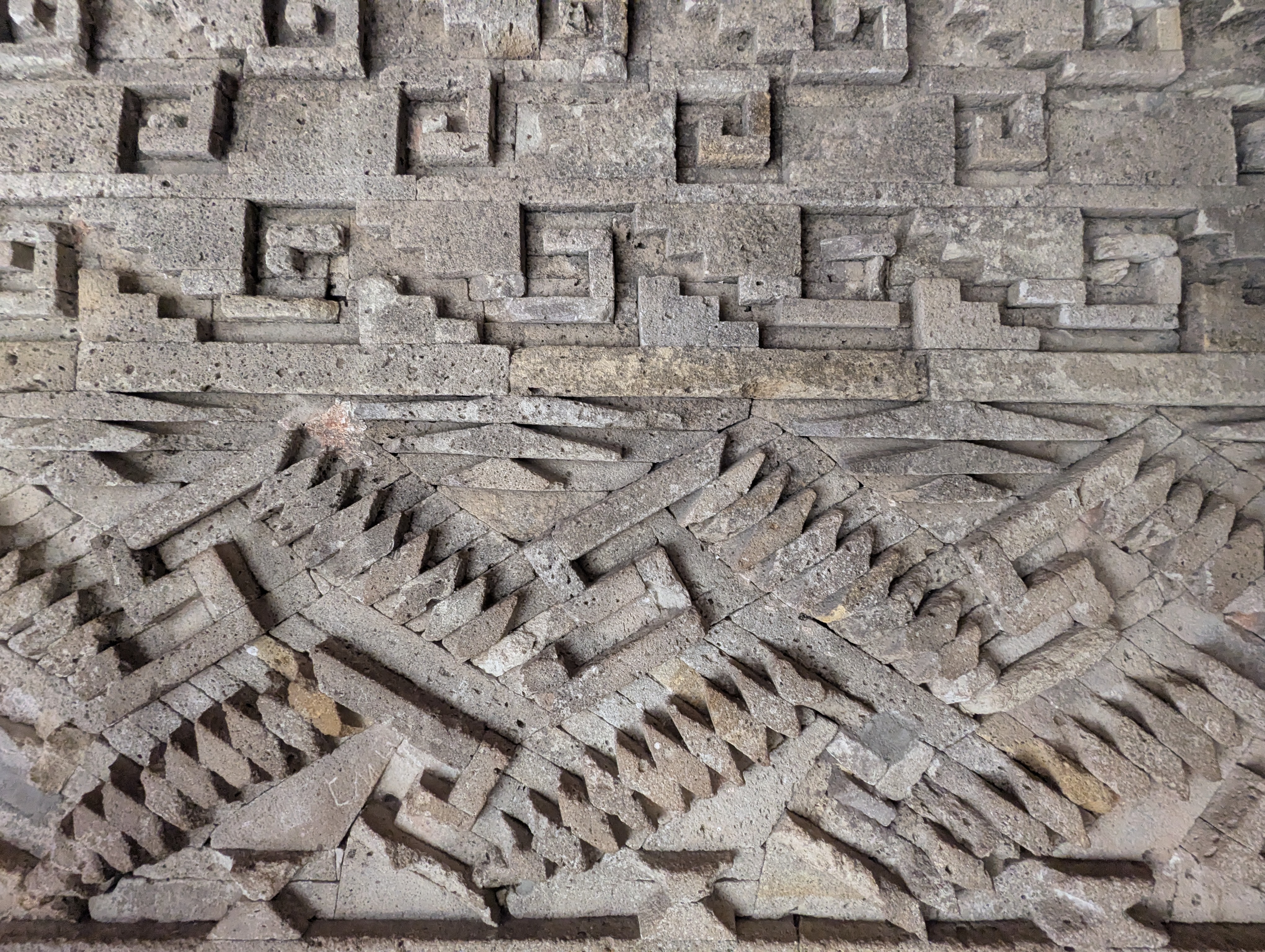
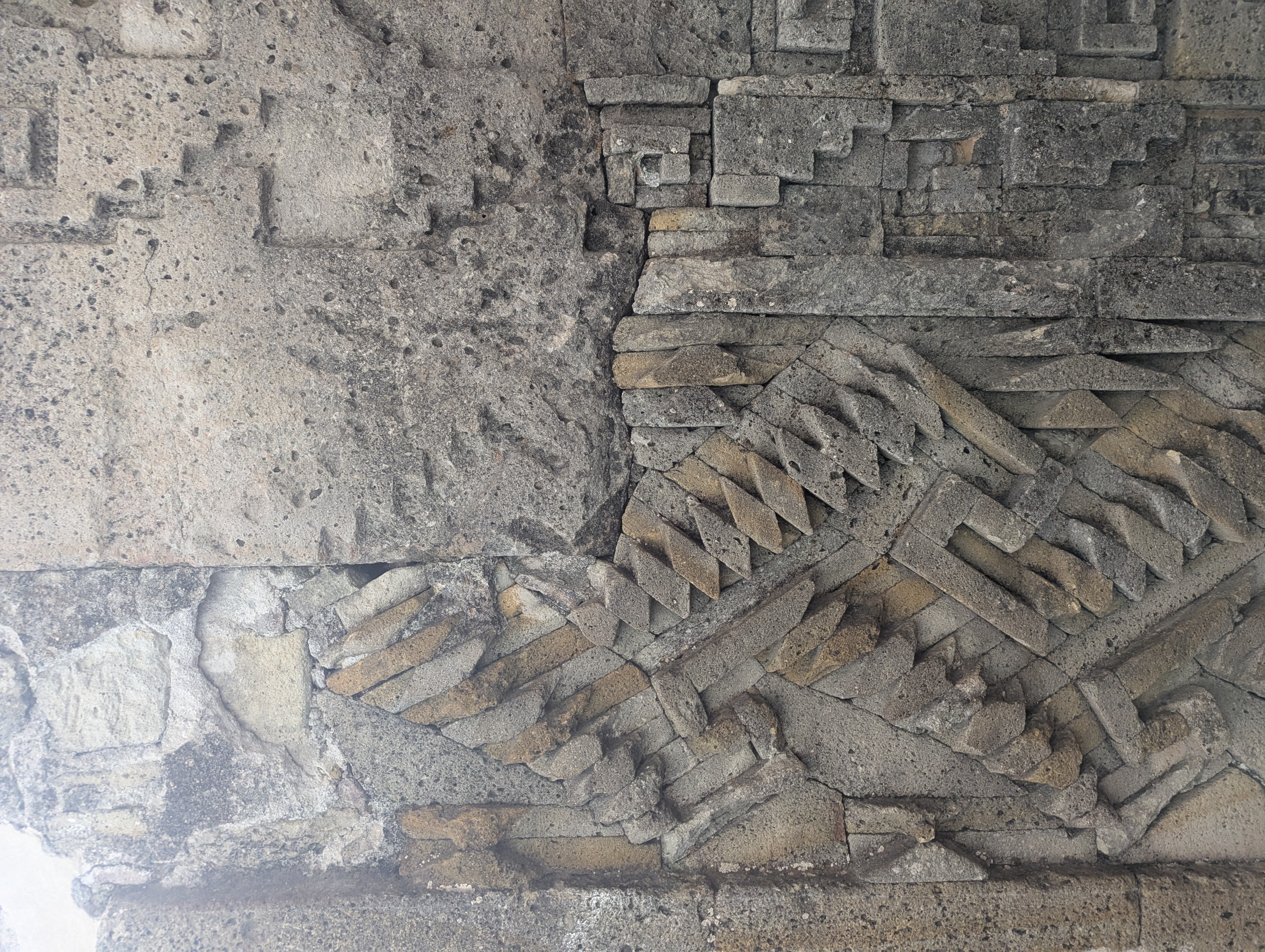
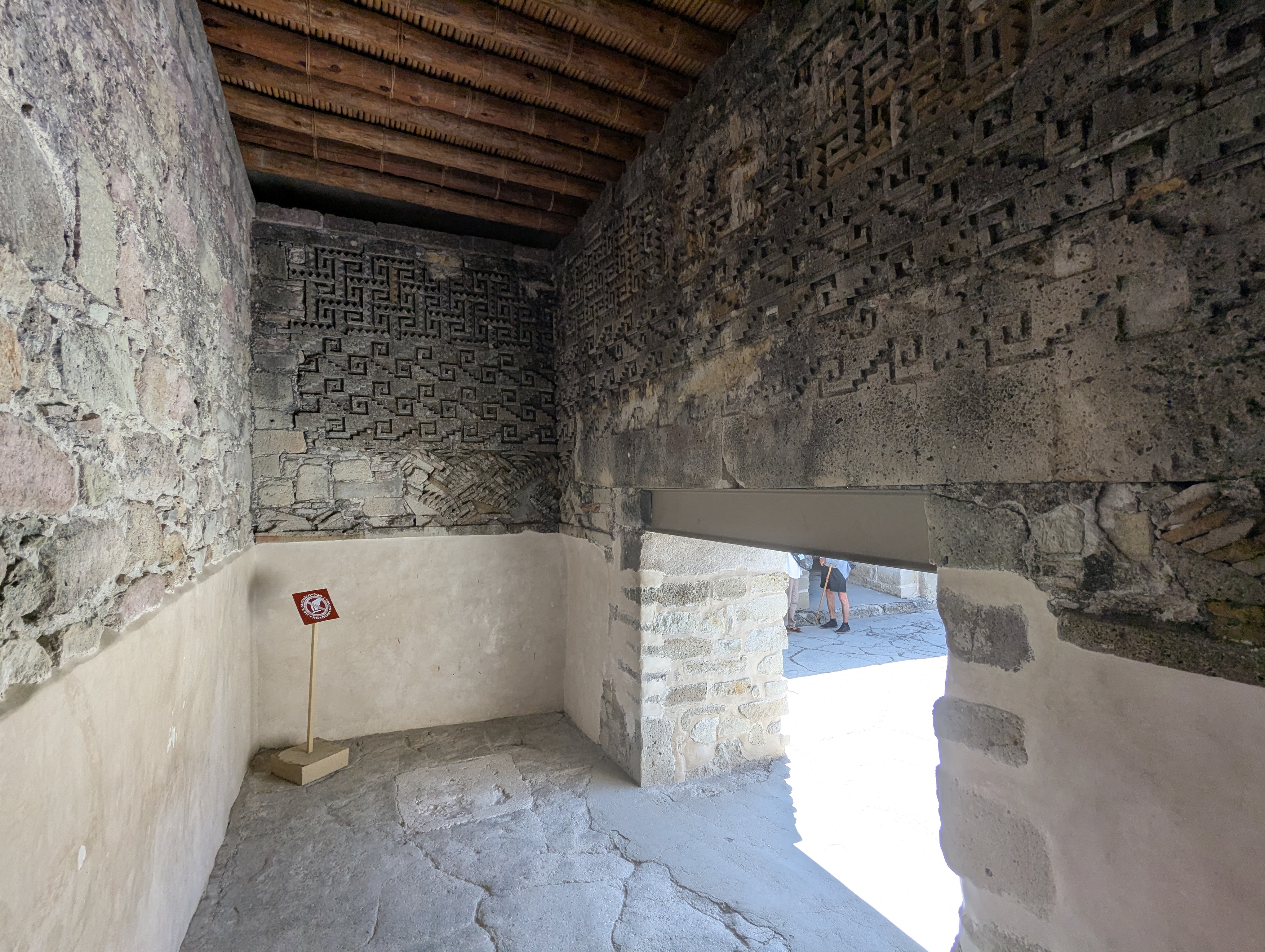
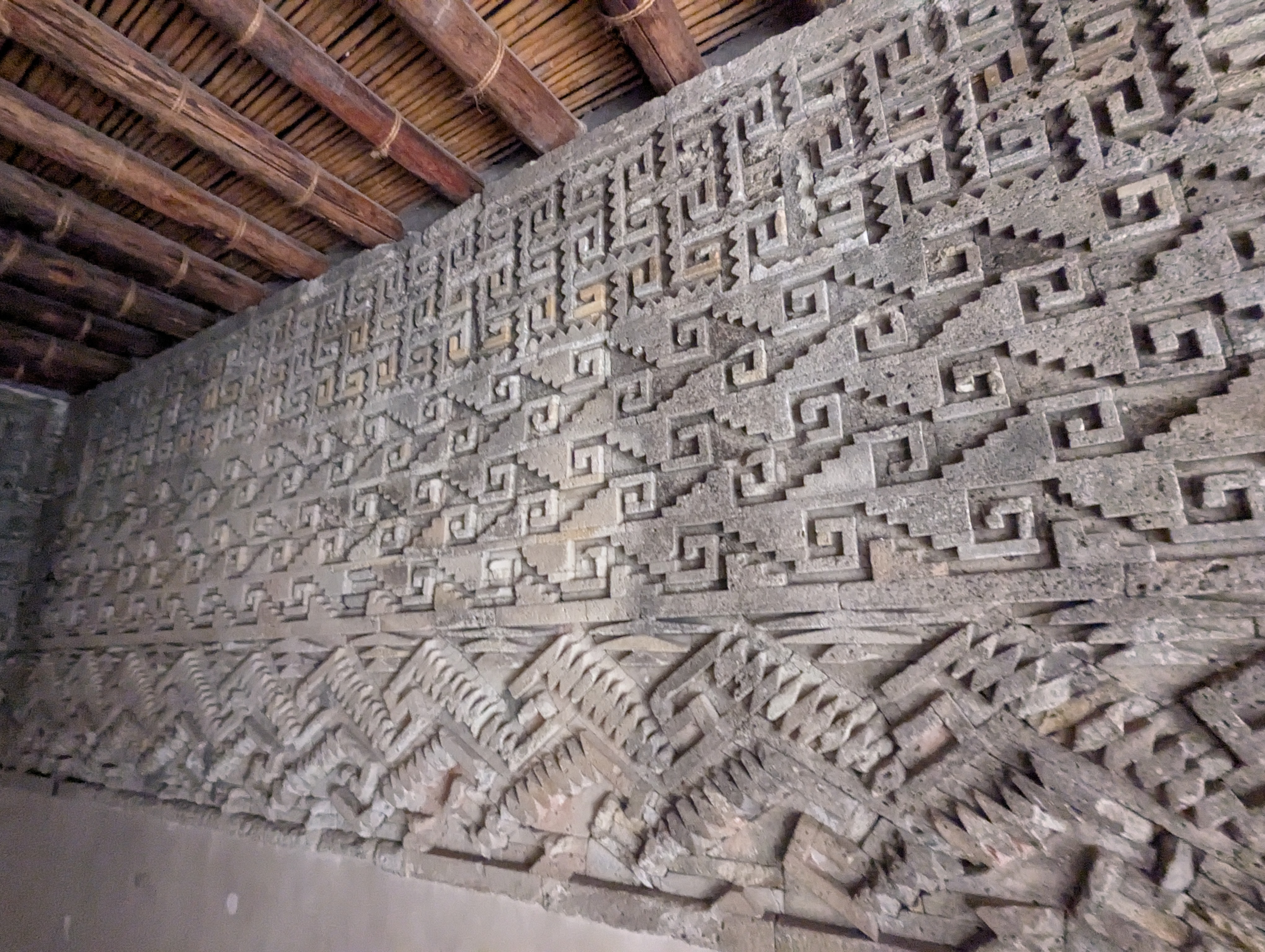
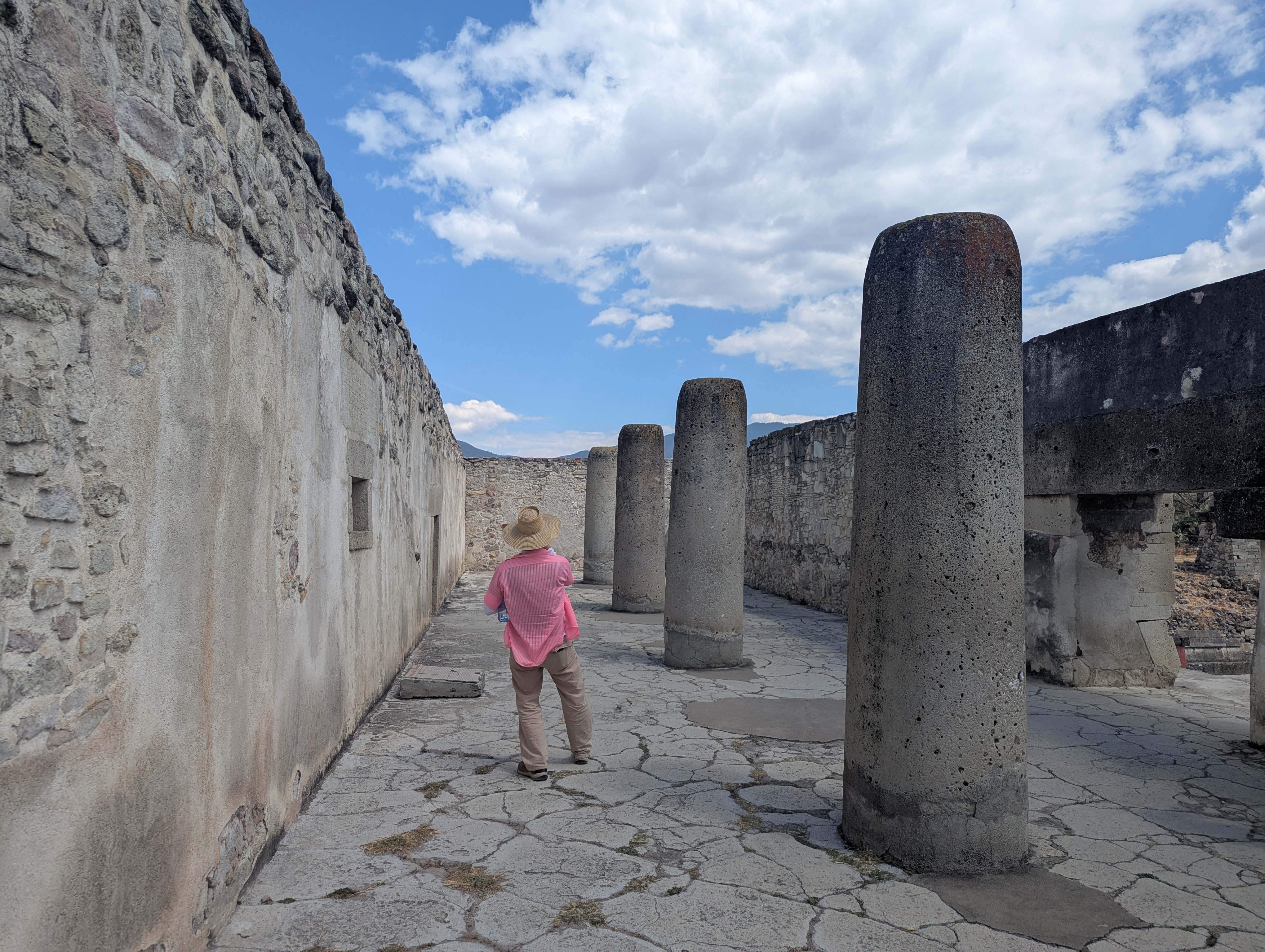
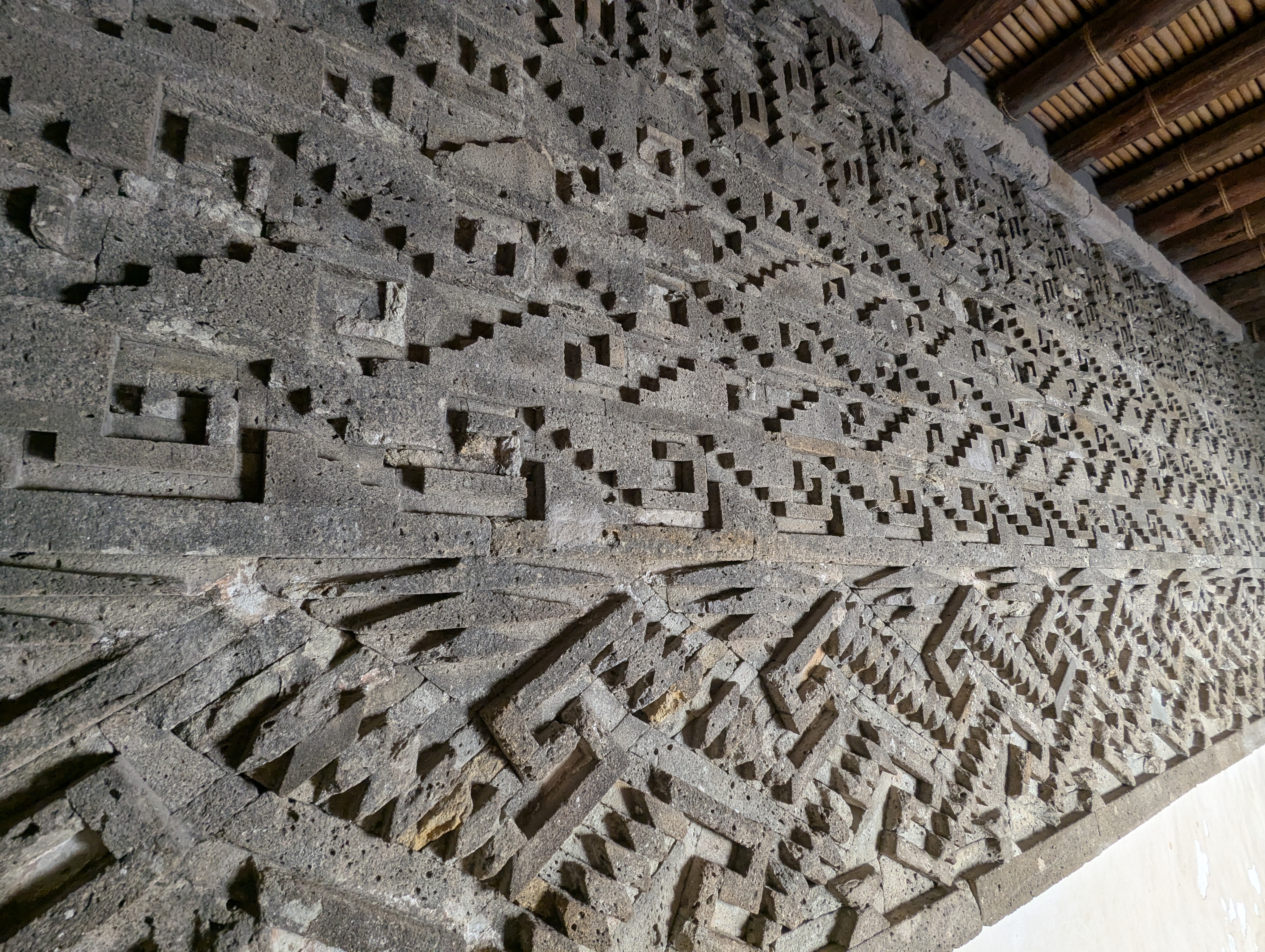
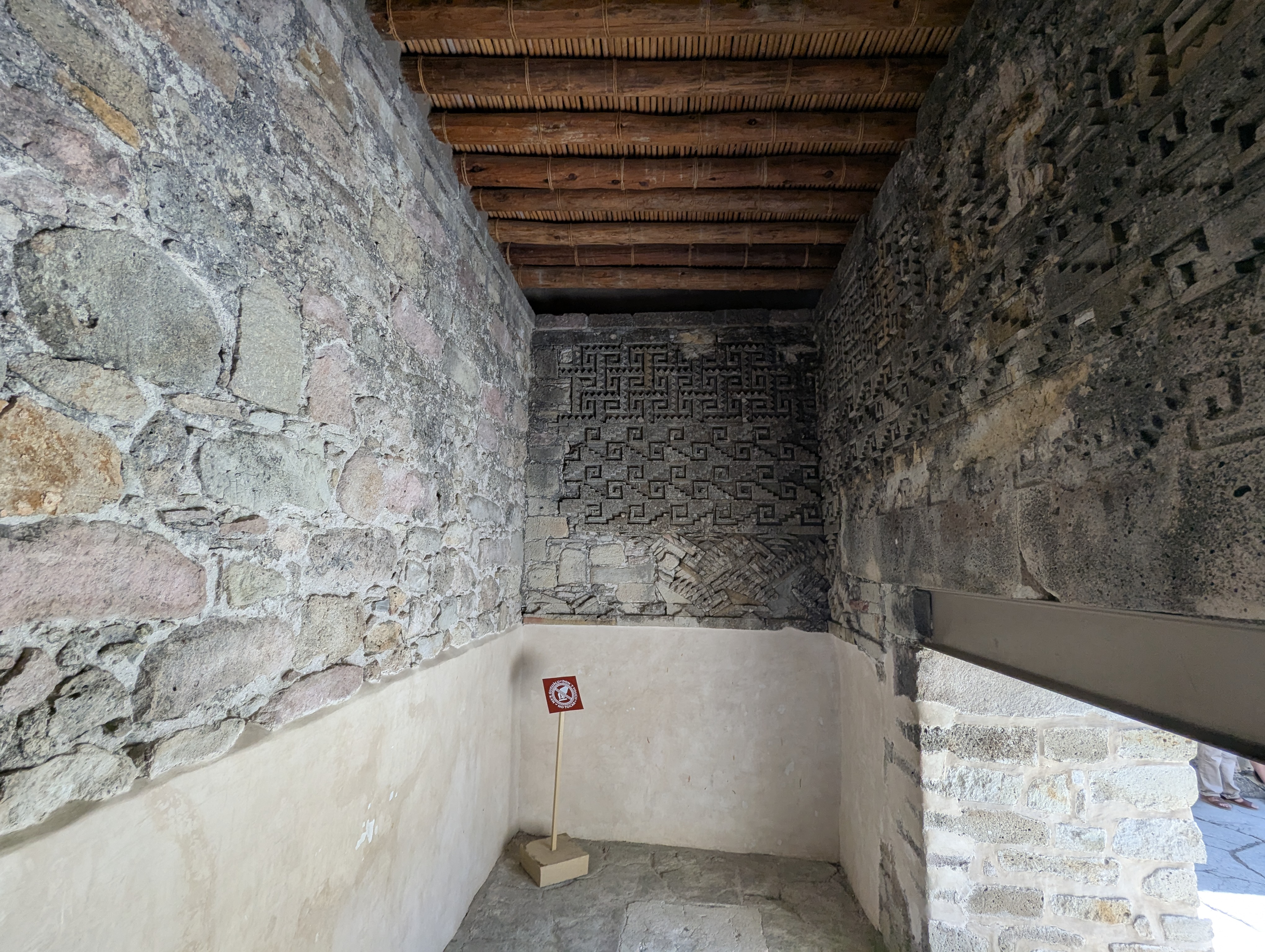
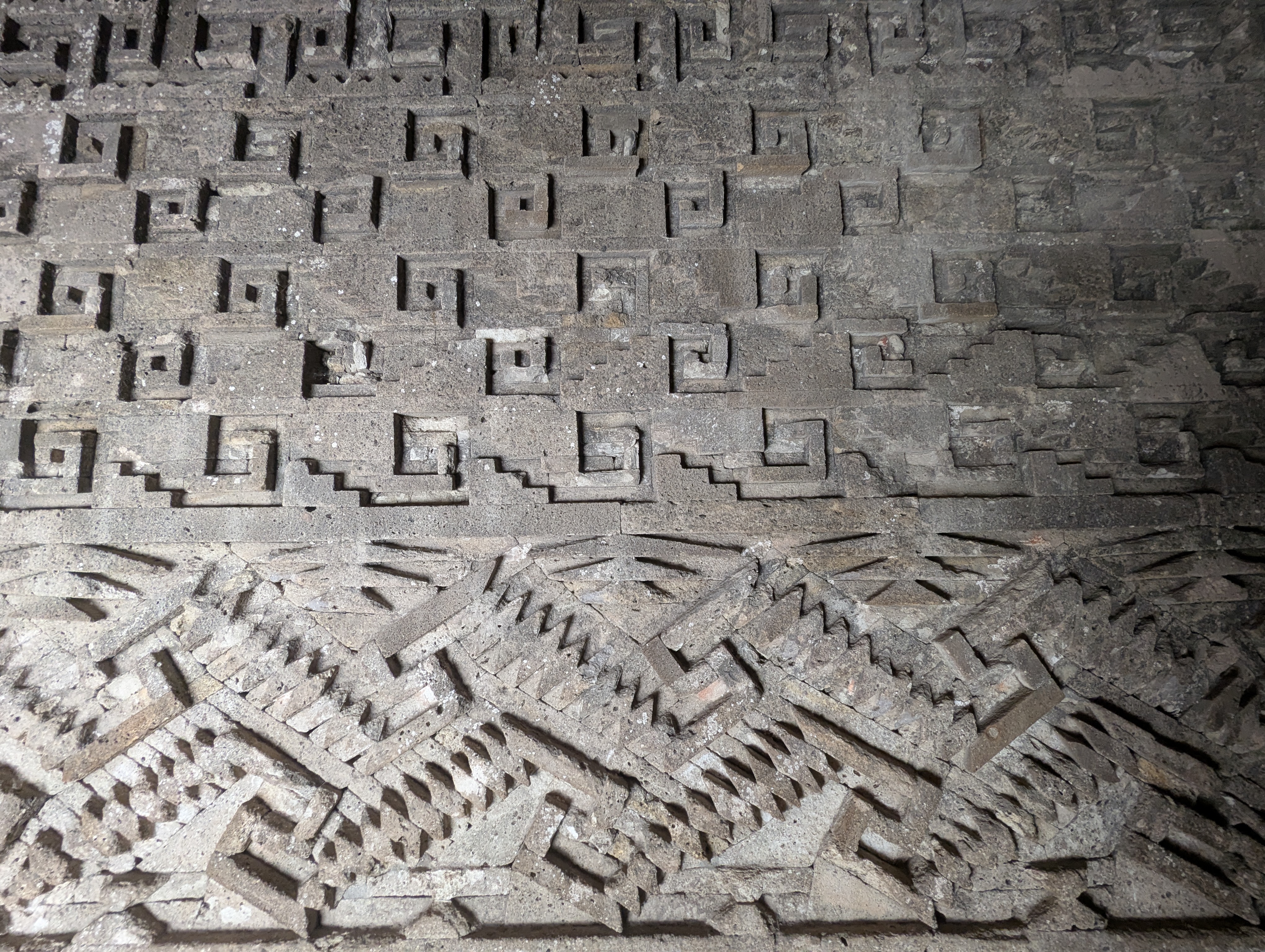
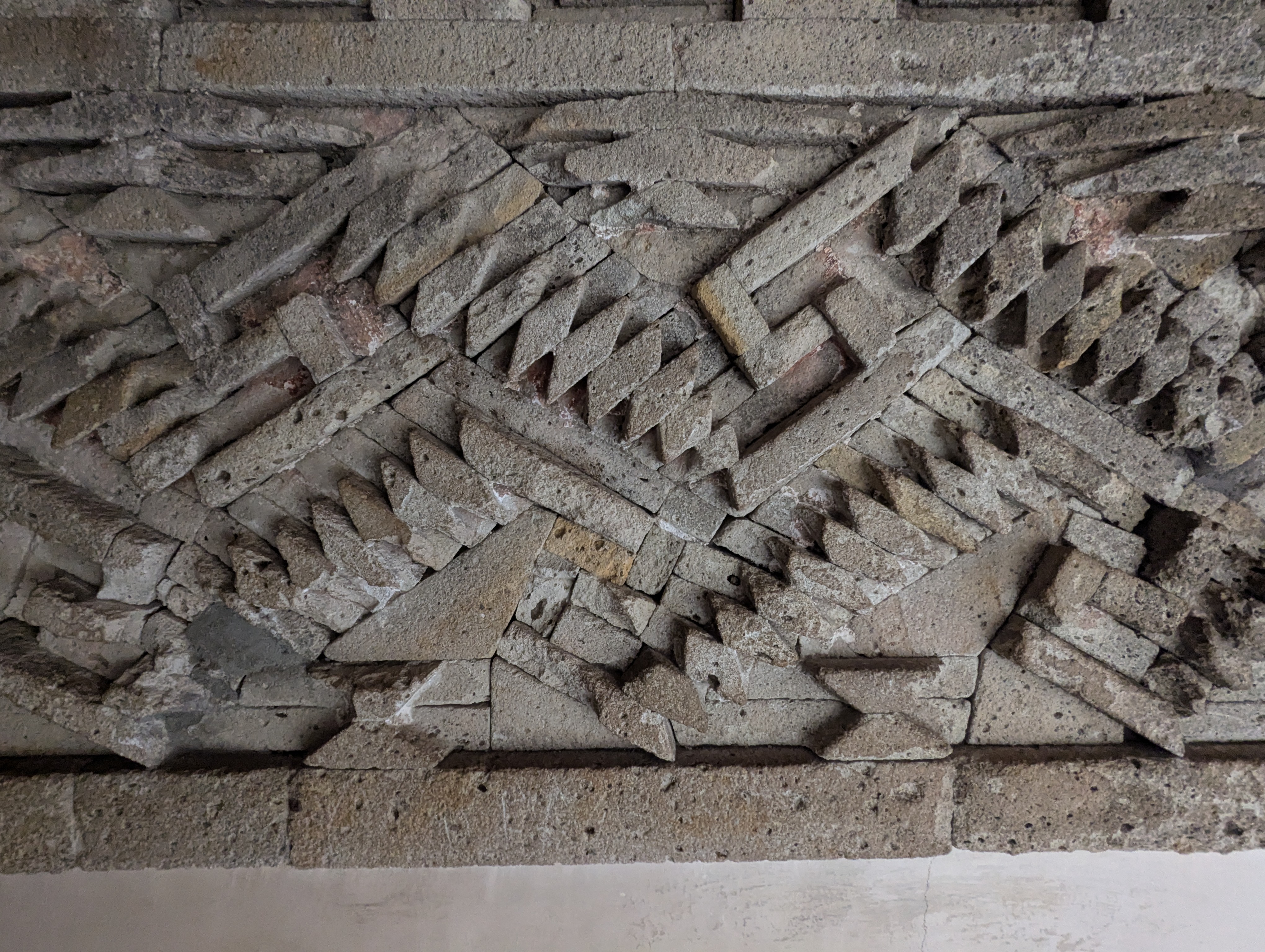
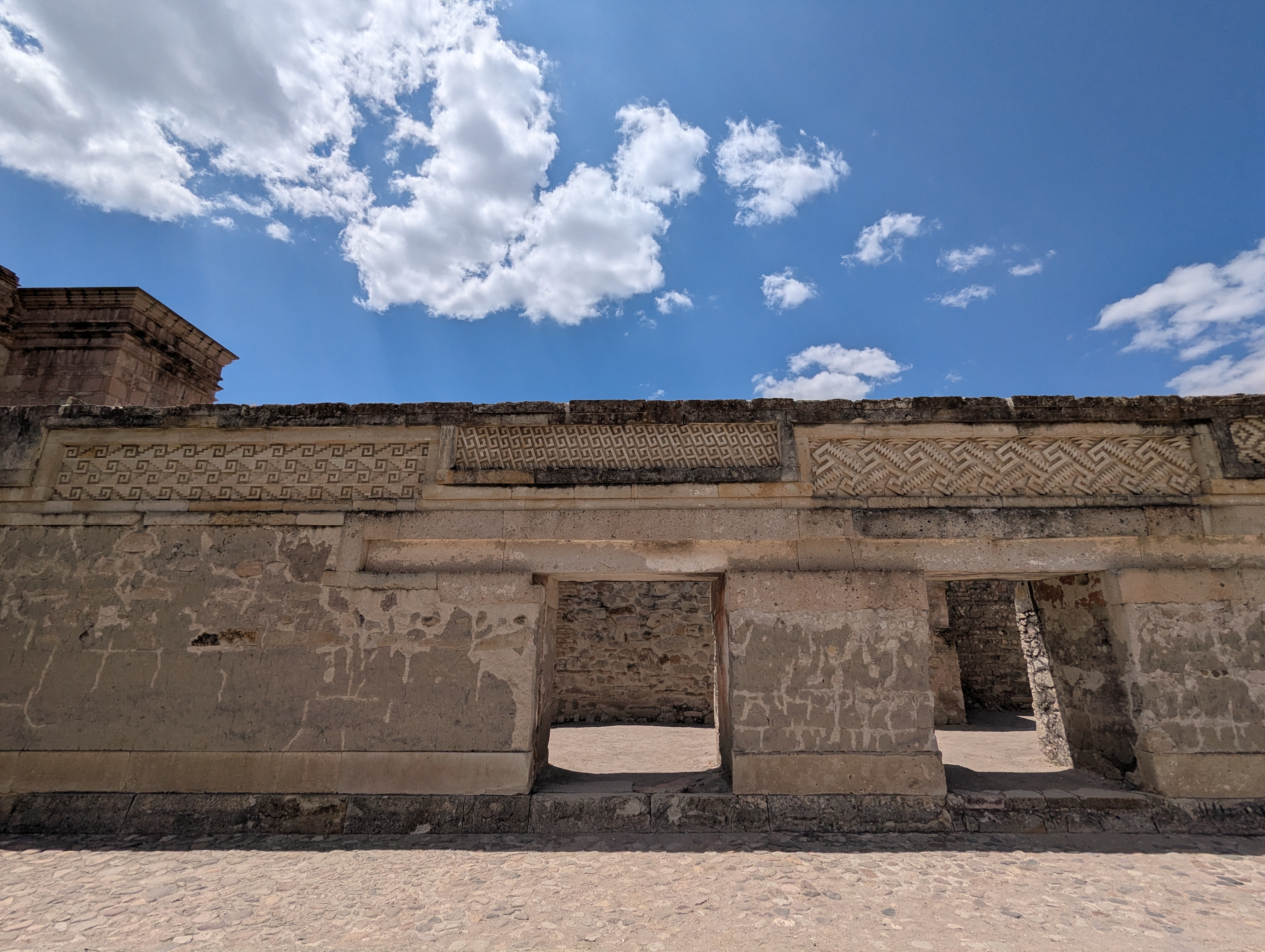
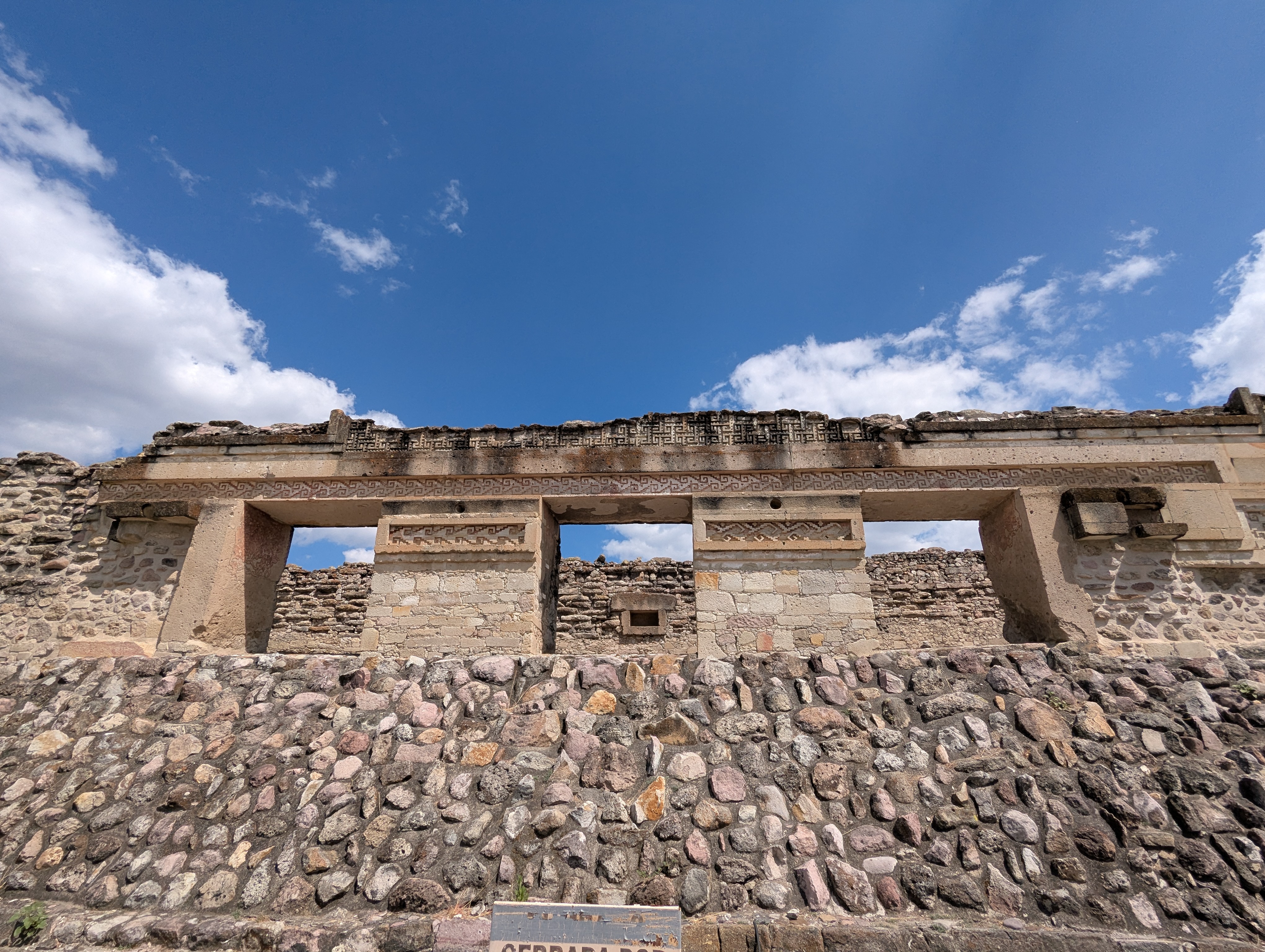
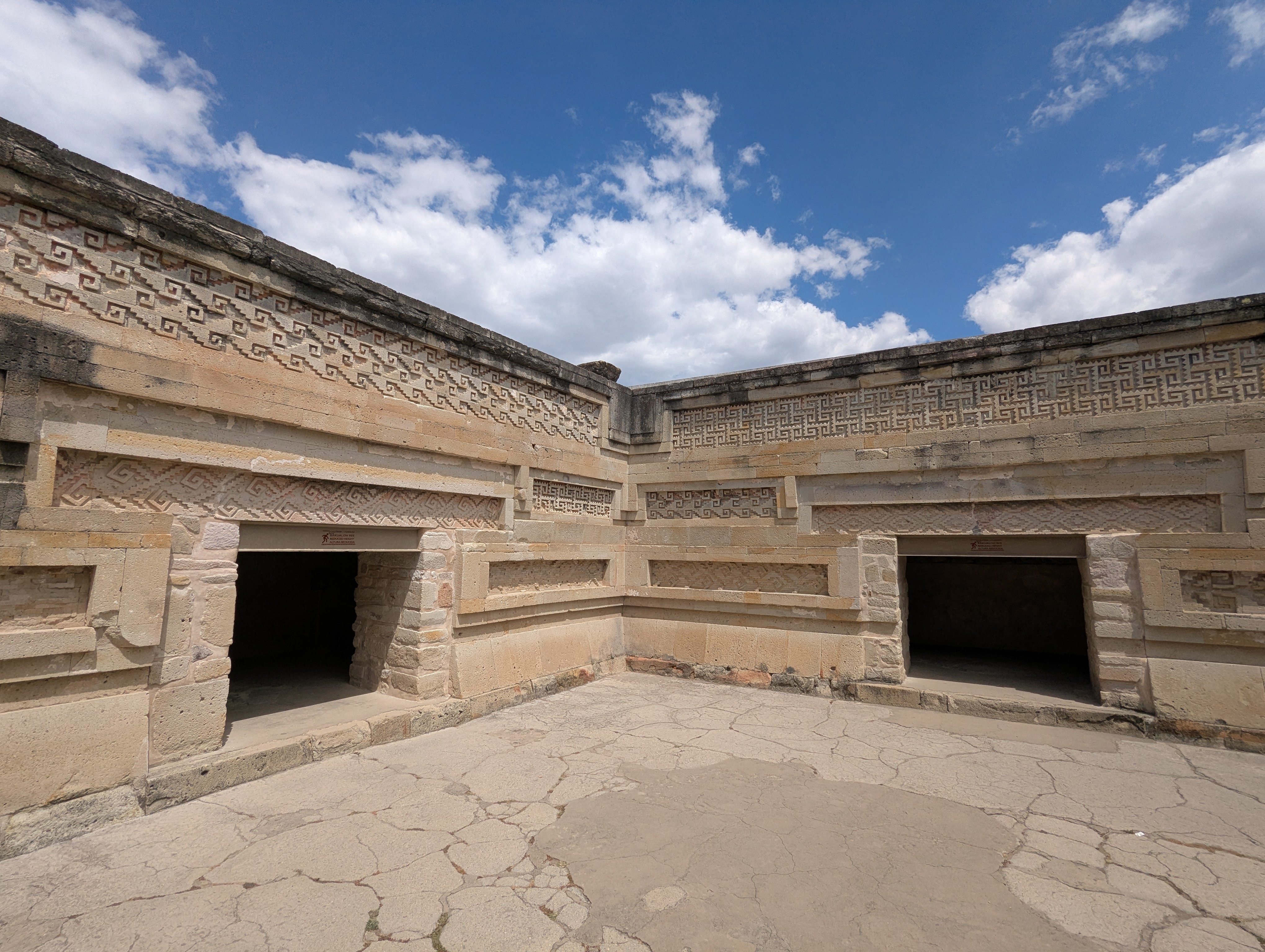
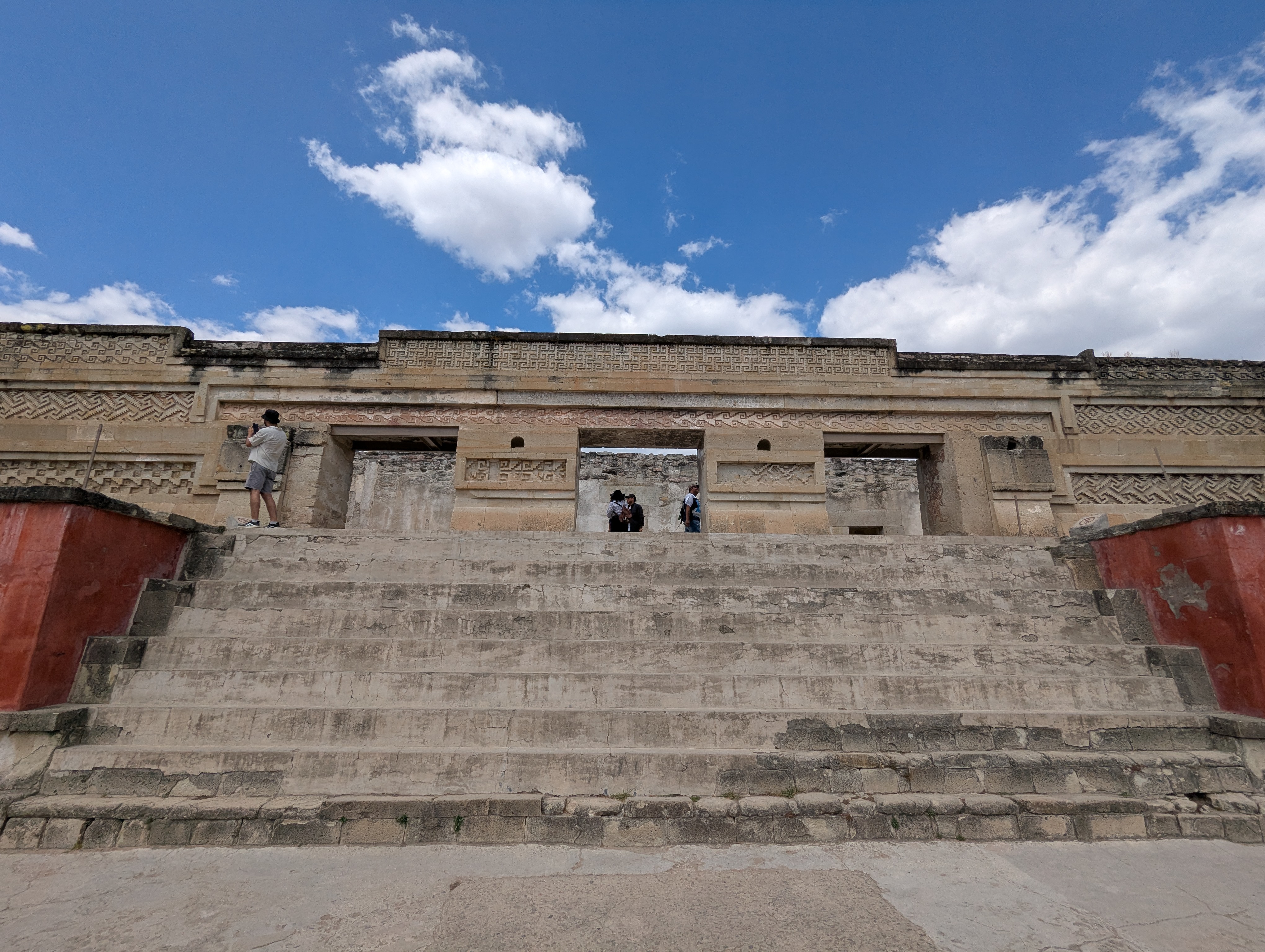
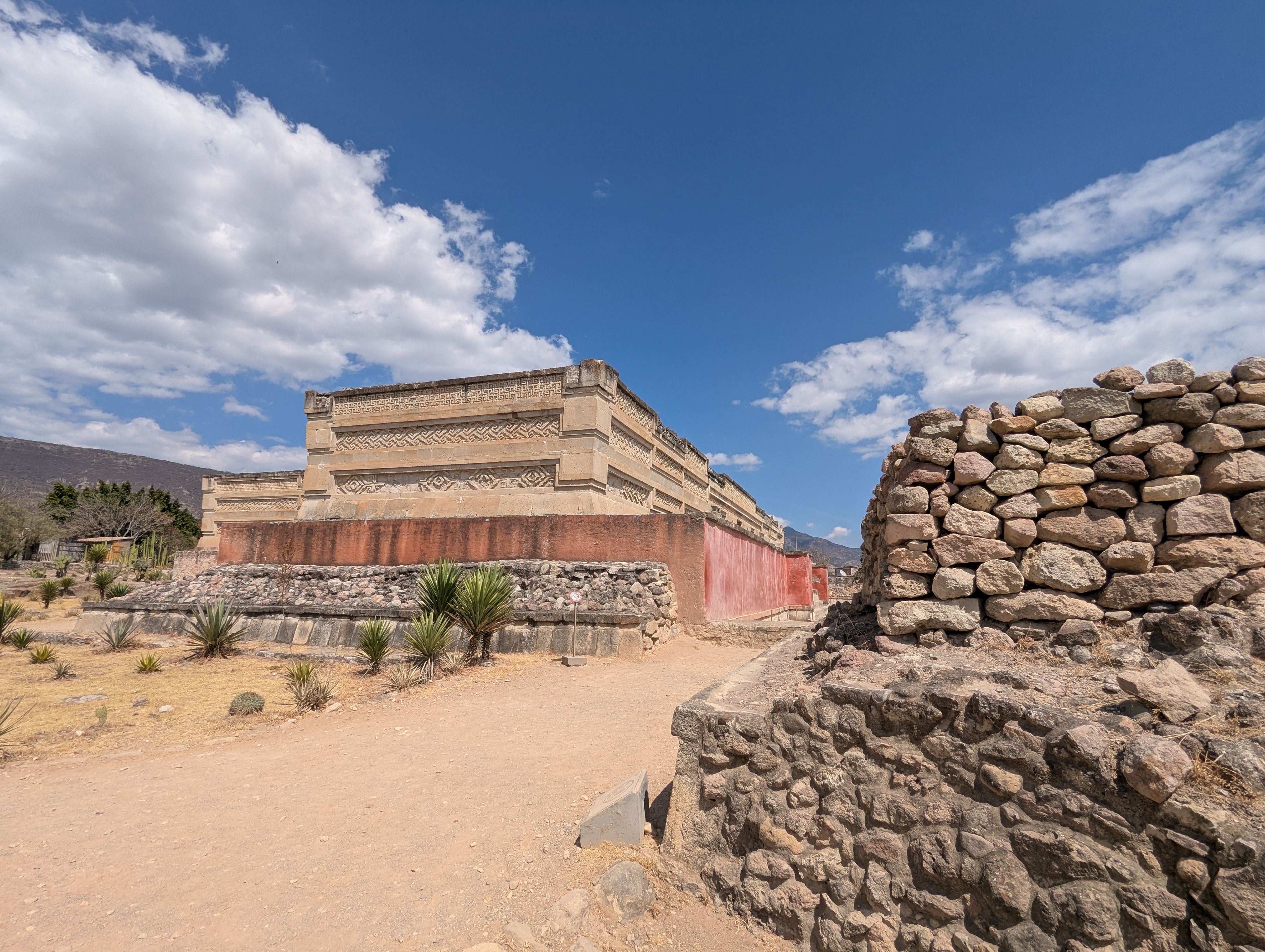
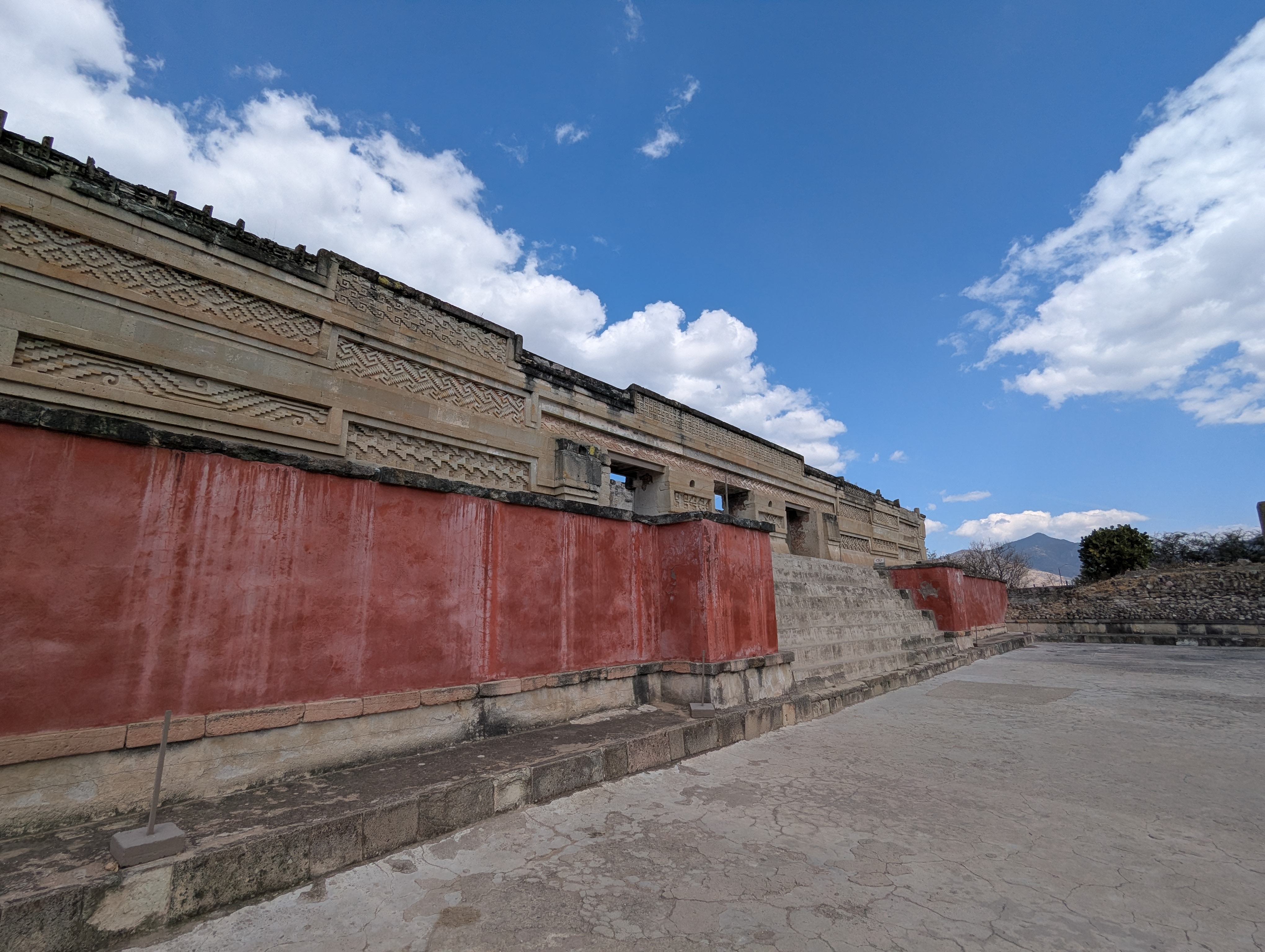
San Pablo Villa de Mitla (Mitla for short,) located in the Tlacolula Valley east of Oaxaca City, is for me an intellectually compelling archaeological site, as well as iconographically truly an inspiration. Unlike some pre-Hispanic sites, where meaning is conveyed through sculpture or painted imagery, Mitla communicates through architectural geometry. The beautiful grecas (intricate mosaic fretwork covering the walls of the palaces) are constructed from thousands of precisely cut stone pieces fitted together without mortar, creating repeating step-frets, spirals, and labyrinthine patterns. The level of expertise and artistry is mind-boggling.
These designs are not merely decorative; they function as a visual language rooted in Zapotec and Mixtec cosmology, where repetition, symmetry, and directional movement evoke ideas of duality, eternity, and the layered structure of the universe.
For me, the grecas read as a symbolic path, a kind of architectural glyph that suggests movement between worlds: life and death, earth and sky, the human and the divine.
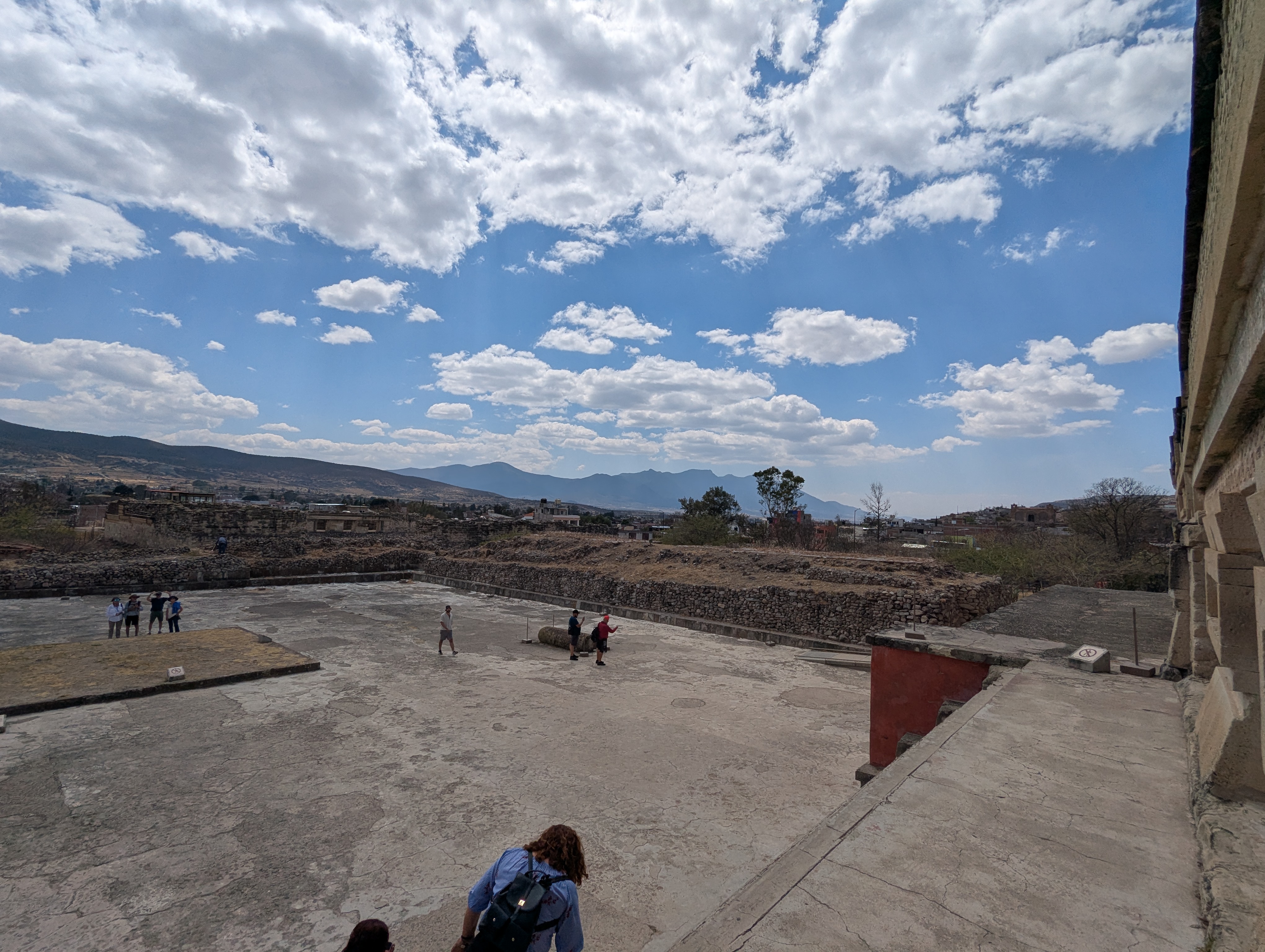
This corresponds with both the site’s Mixteca name which derives from the Nahuatl “Mictlán,” meaning “place of the dead,” as well as the older Zapotec Lyobaa, meaning “place of rest,” emphasizing its long-standing association with the afterlife and ritual continuity. The architecture reinforces this association. Beneath the courtyards lie cruciform tombs, while above them the walls are wrapped in fantastic (almost hypnotic) geometric sequences, as if the surface itself were a threshold between visible and invisible realms. The grecas do not depict gods or rulers; instead they express order, continuity, and cosmic balance, making Mitla an abstract and philosophically sophisticated visual environ.
On the site there are:
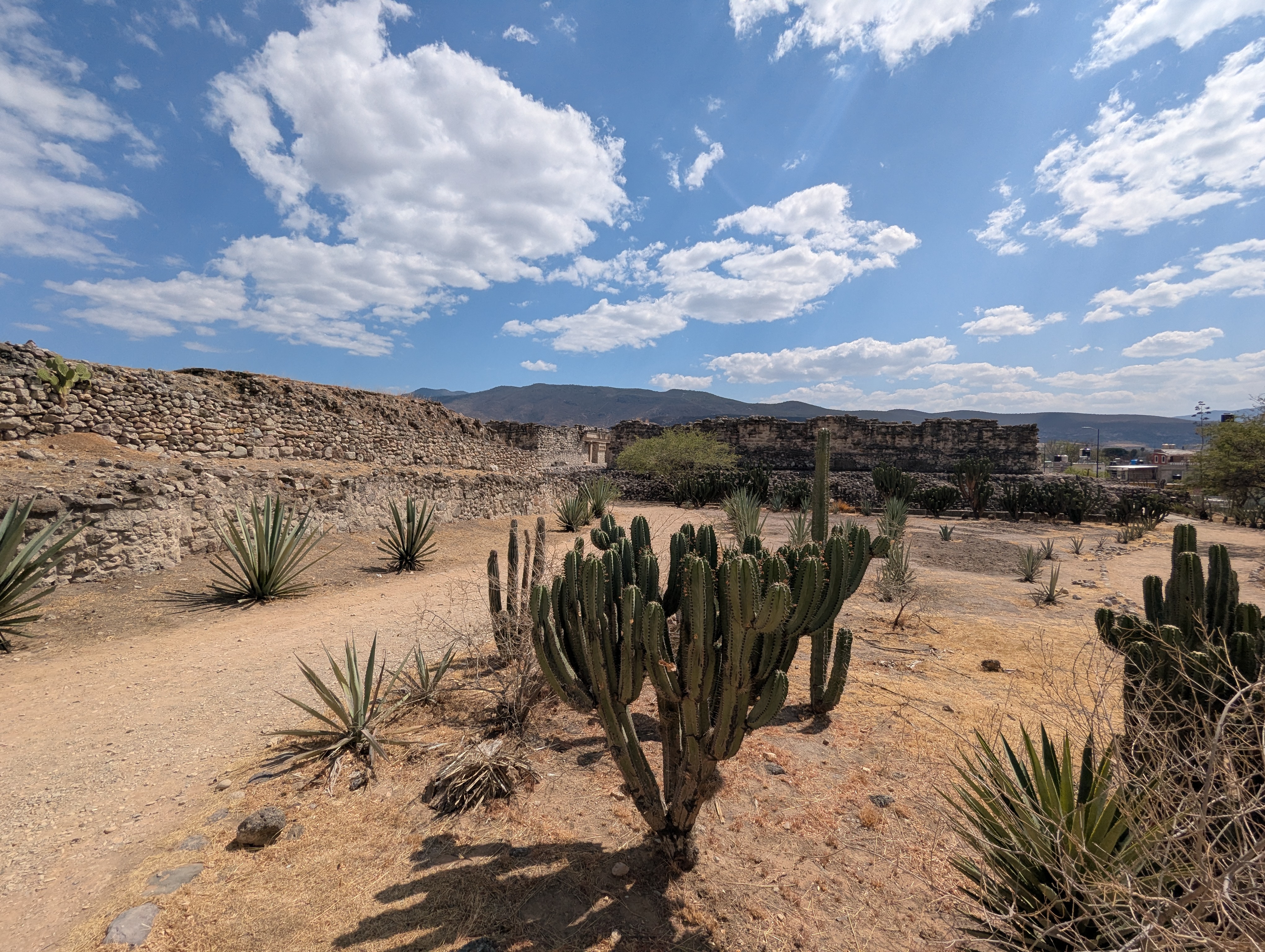
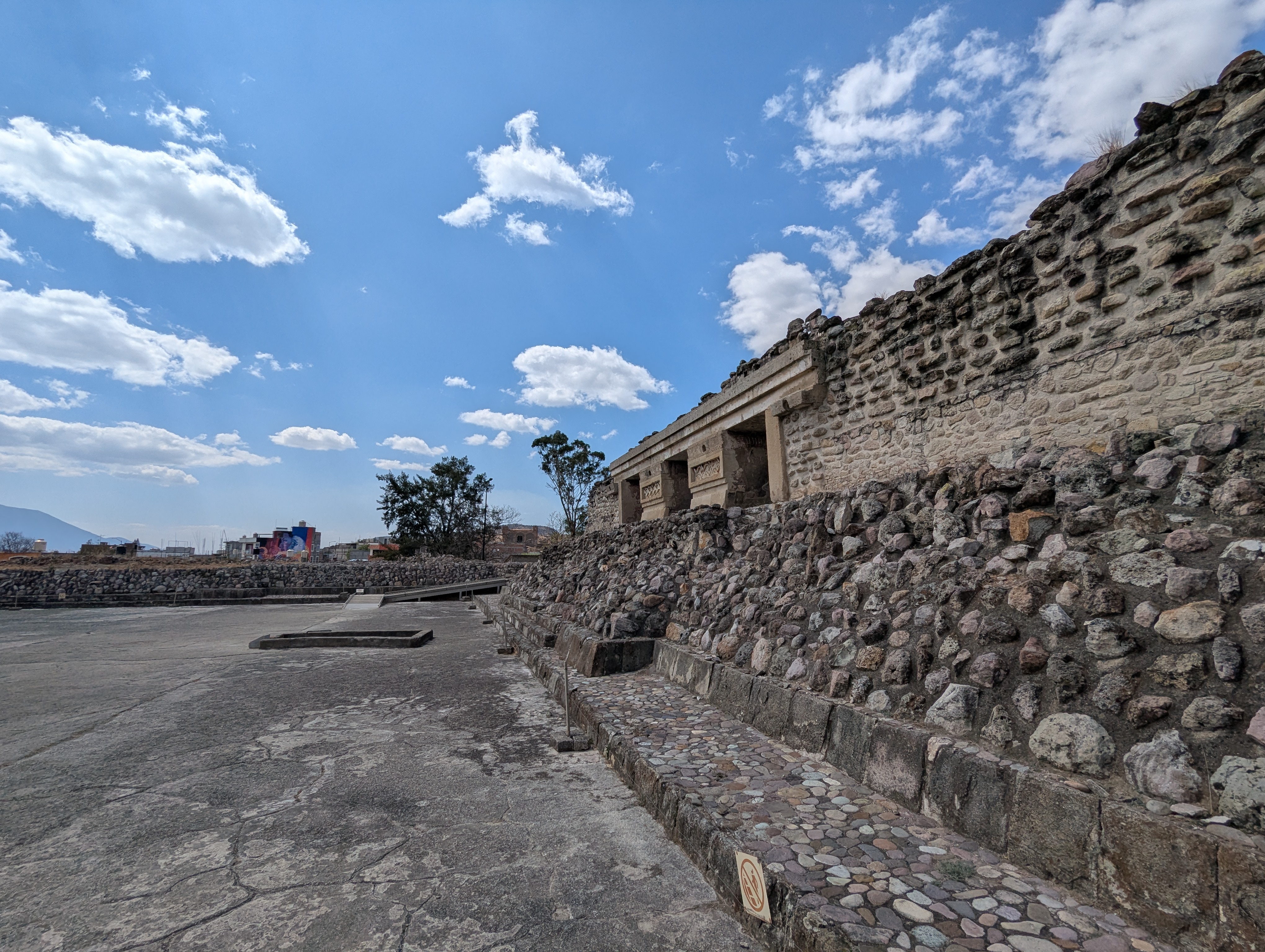
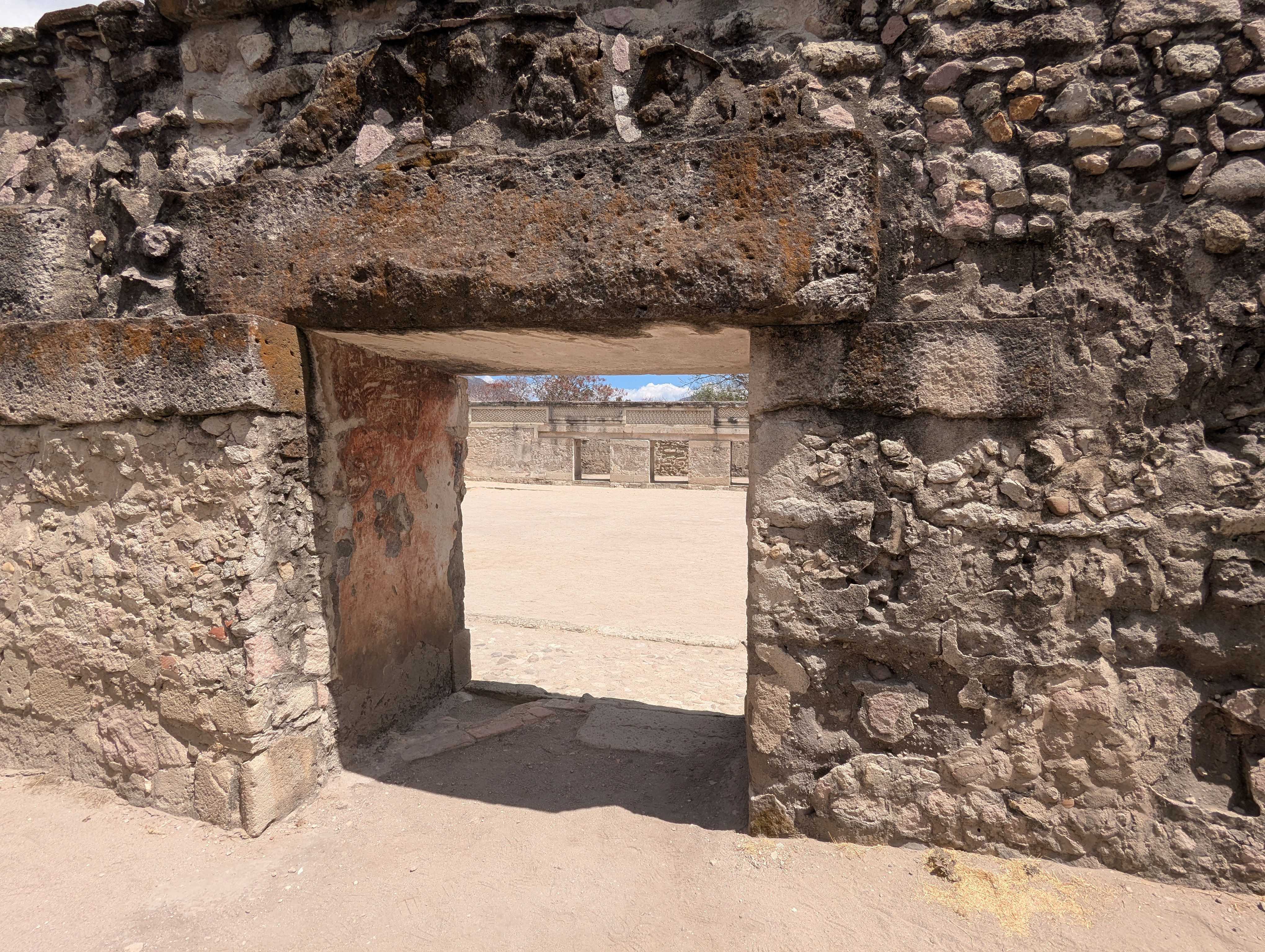
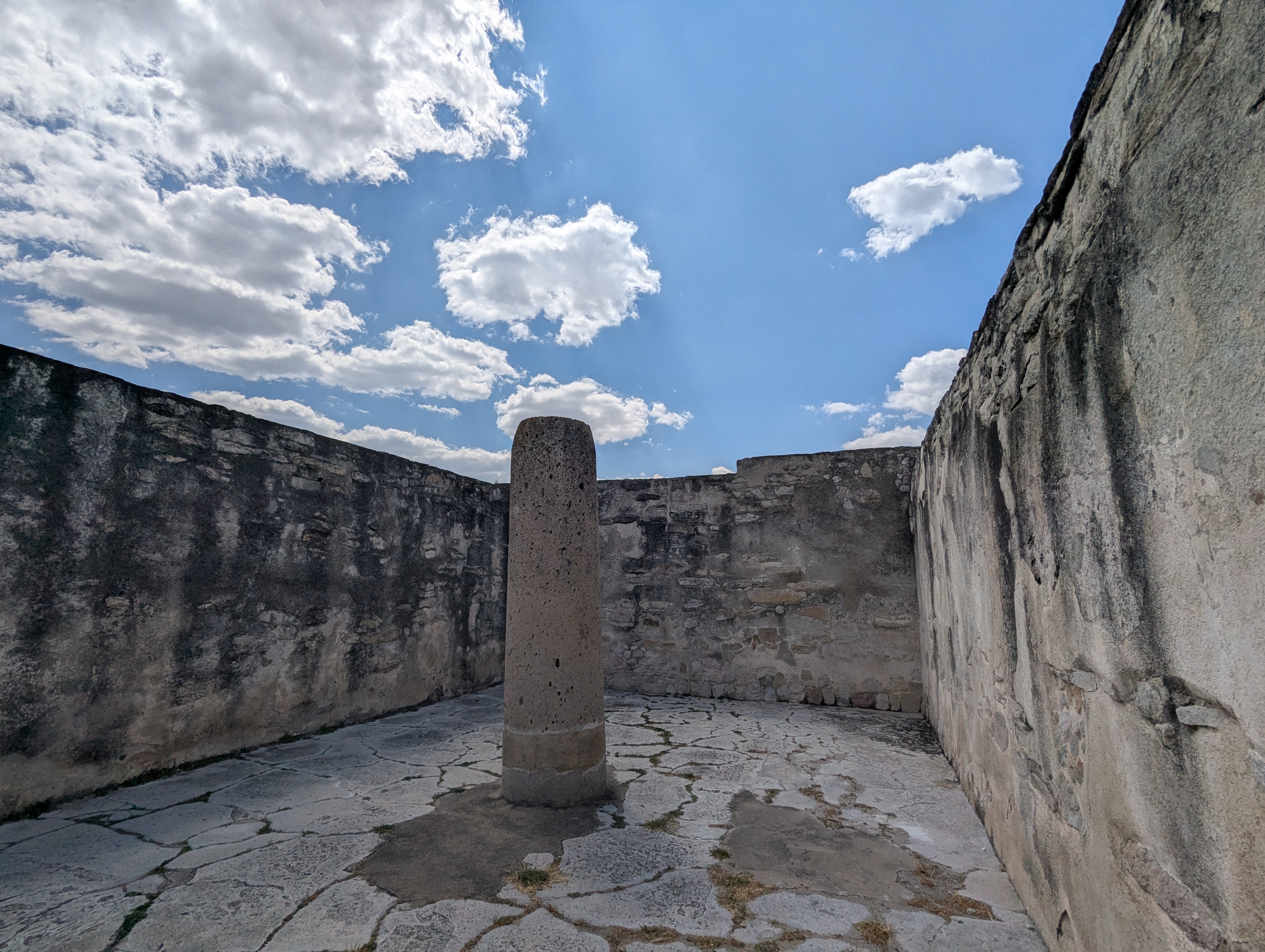
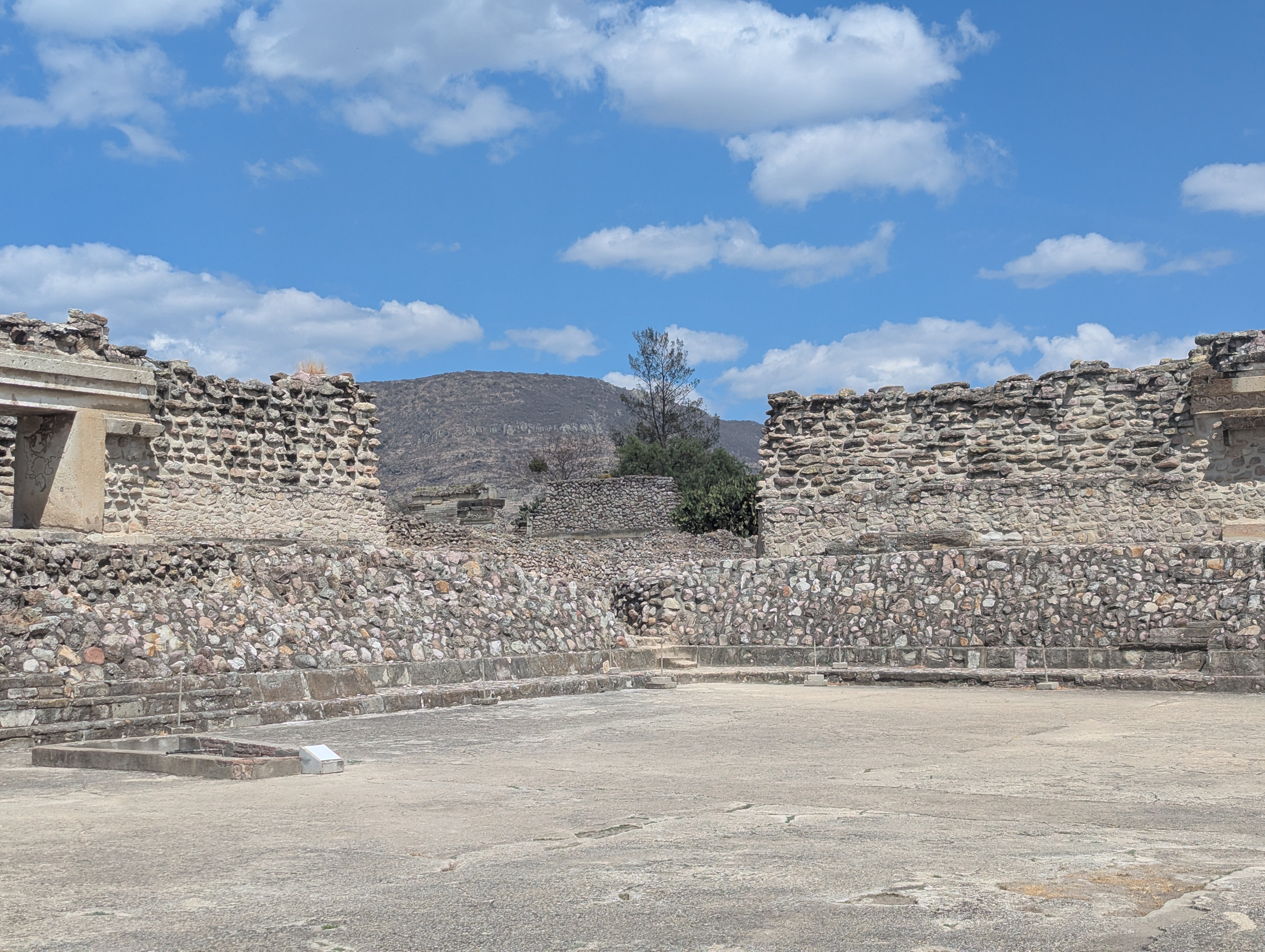
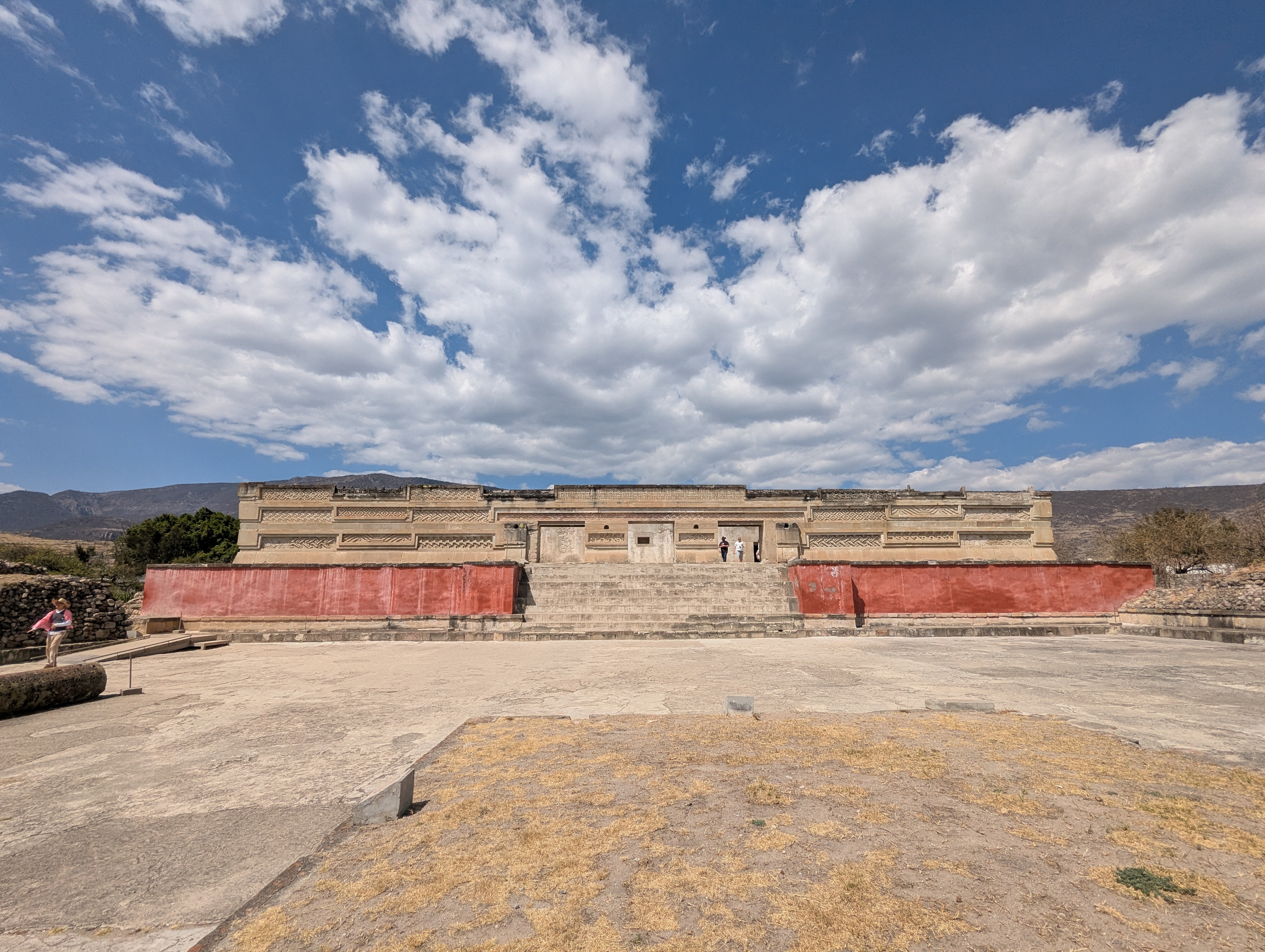
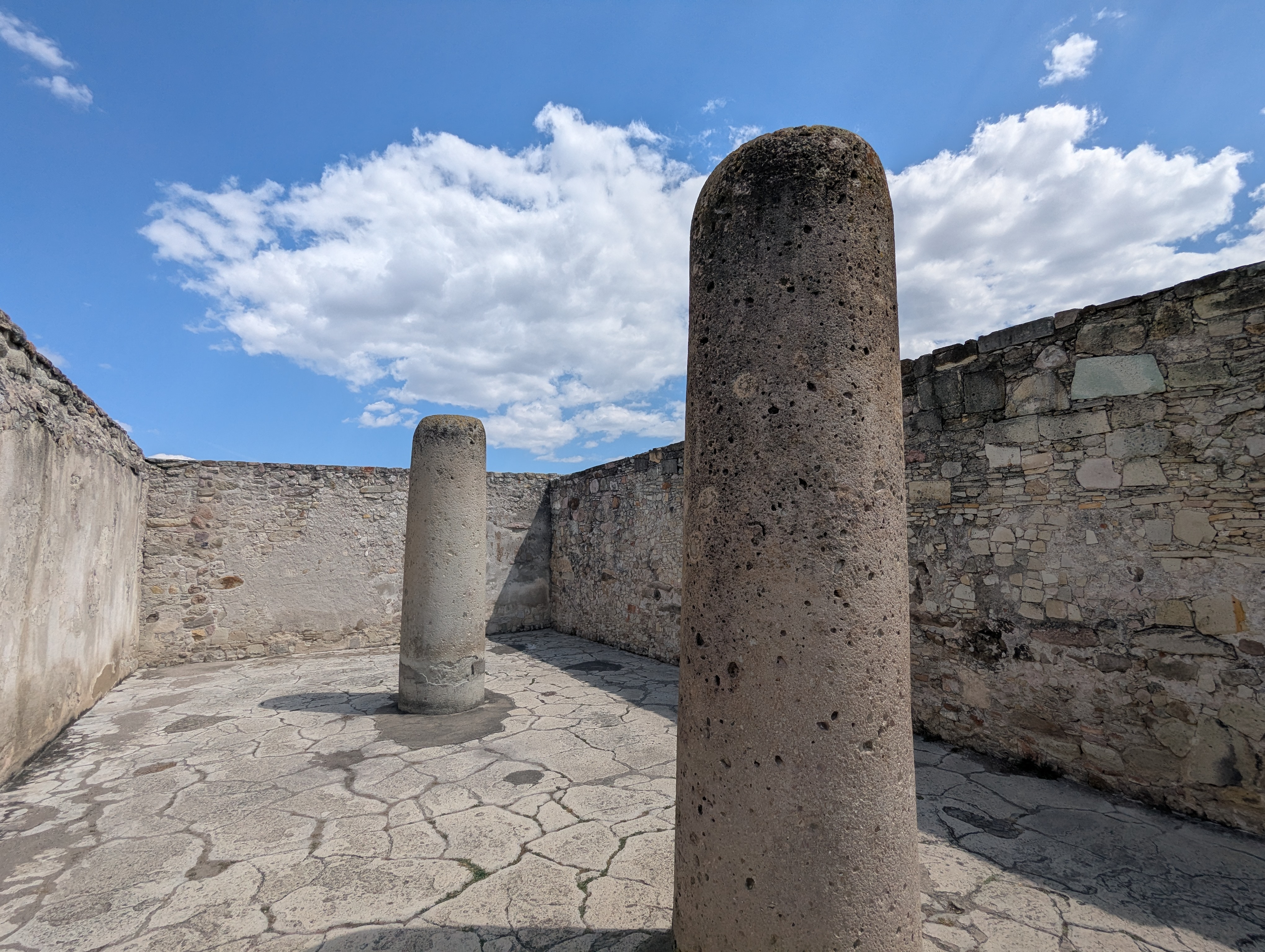
“Five groupings of monumental architecture remain from ancient Mitla: the Northern Group, the Column Group, the Stream Group, the Adobe or Calvary Group and the Southern Group. The latter two date from an earlier age and are similar in style to Monte Albán (plazas bordered by palaces erected on platforms). The other three consist of three quadrangular courtyards interconnected with walkways.” (https://lugares.inah.gob.mx/en/node/4350)
Mitla, occupies a unique position within the history of ancient Oaxaca as a major ceremonial and funerary center that flourished after the decline of Monte Albán. While Monte Albán dominated the region during the Classic period (ca. 500 BCE–750 CE), Mitla rose to prominence in the Late Classic and Postclassic periods (ca. 900–1521 CE), when political power in the Valley of Oaxaca became more decentralized. Archaeological and ethnohistorical evidence suggests that the site was inhabited first by the Zapotec and later by the Mixtec, who maintained and expanded the ceremonial complexes, transforming Mitla into an important religious center associated with ancestry, burial, and priestly authority.
A literature review of the scholarly works on Mitla reveals that the site has been consistently interpreted as a Late Classic and Postclassic ceremonial and funerary center of exceptional architectural refinement, whose geometric mosaics, subterranean tombs, and layered construction have attracted sustained attention from archaeologists, art historians, and material culture scholars interested in questions of cosmology, political authority, colonial transformation, and the persistence of Indigenous design traditions in the Oaxaca Valley. Scholarly attention to Mitla has long emphasized the site’s distinctive architectural program within the broader archaeological history of Oaxaca. Early systematic studies by Alfonso Caso (1938) and Ignacio Bernal (1965) established the chronological relationship between Monte Albán and Mitla, identifying the latter as a major Late Classic and Postclassic ceremonial center associated with Zapotec and later Mixtec occupation. Subsequent archaeological work has reinforced the interpretation of Mitla as a funerary and priestly complex, in which palatial structures built above cruciform tombs reflect a cosmological understanding of the relationship between the living and the dead (Paddock 1983; Marcus and Flannery 1996). These studies situate Mitla within the shifting political landscape of the Valley of Oaxaca after the decline of Monte Albán, when regional authority became more decentralized and ritual centres gained renewed importance as loci of lineage, ancestry, and sacred knowledge.
The architectural mosaics known as grecas have attracted particular scholarly interest because of their technical precision and elegant iconographic restraint (as well as the fact that Mitla is the only site in MesoAmerica with this architectural detailing). Unlike the figural reliefs common in other Mesoamerican sites, Mitla’s surfaces are dominated by geometric fretwork composed of individually cut stones assembled without mortar, a construction method that has been interpreted as both a technological achievement and a symbolic system (Kubler 1962; Boone 2000). Researchers have proposed that these patterns functioned as visual expressions of cosmological order, encoding ideas of duality, cyclicality, and directional movement that were central to Zapotec and Mixtec worldviews (Urcid 2001; Joyce 2010). Rather than depicting narrative scenes, the grecas create what Kubler described as a “syntax of form,” in which repetition and variation generate meaning through structure rather than representation (Kubler 1962). This approach aligns with broader scholarship in Mesoamerican art history that understands architecture as a medium through which metaphysical concepts were materialized in spatial and geometric terms (Boone and Mignolo 1994).
Ethnohistorical sources from the colonial period further reinforce the interpretation of Mitla as a sacred landscape associated with death and ritual continuity. Spanish chroniclers described the site as a residence of Zapotec priests and a place where elite burials were conducted, accounts that correspond closely with the archaeological evidence of tombs beneath the palace complexes (Spores 1965; Marcus 1983). Linguistic evidence also contributes to this interpretation: the Nahuatl name Mitla, derived from Mictlán, meaning “place of the dead,” and the Zapotec term Lyobaa, often translated as “place of rest,” both suggest longstanding associations with the afterlife and ancestral veneration (Marcus and Flannery 1996).
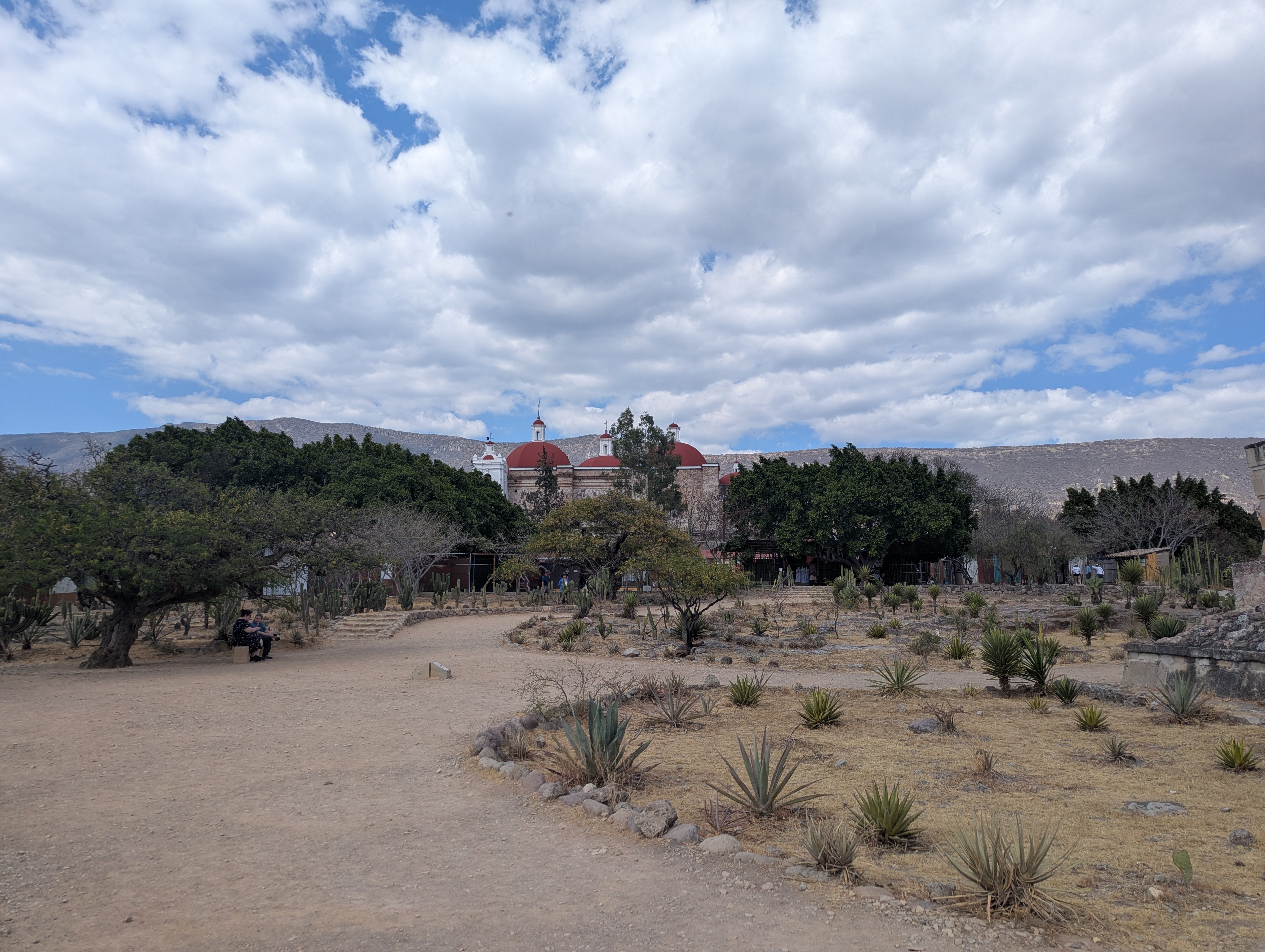
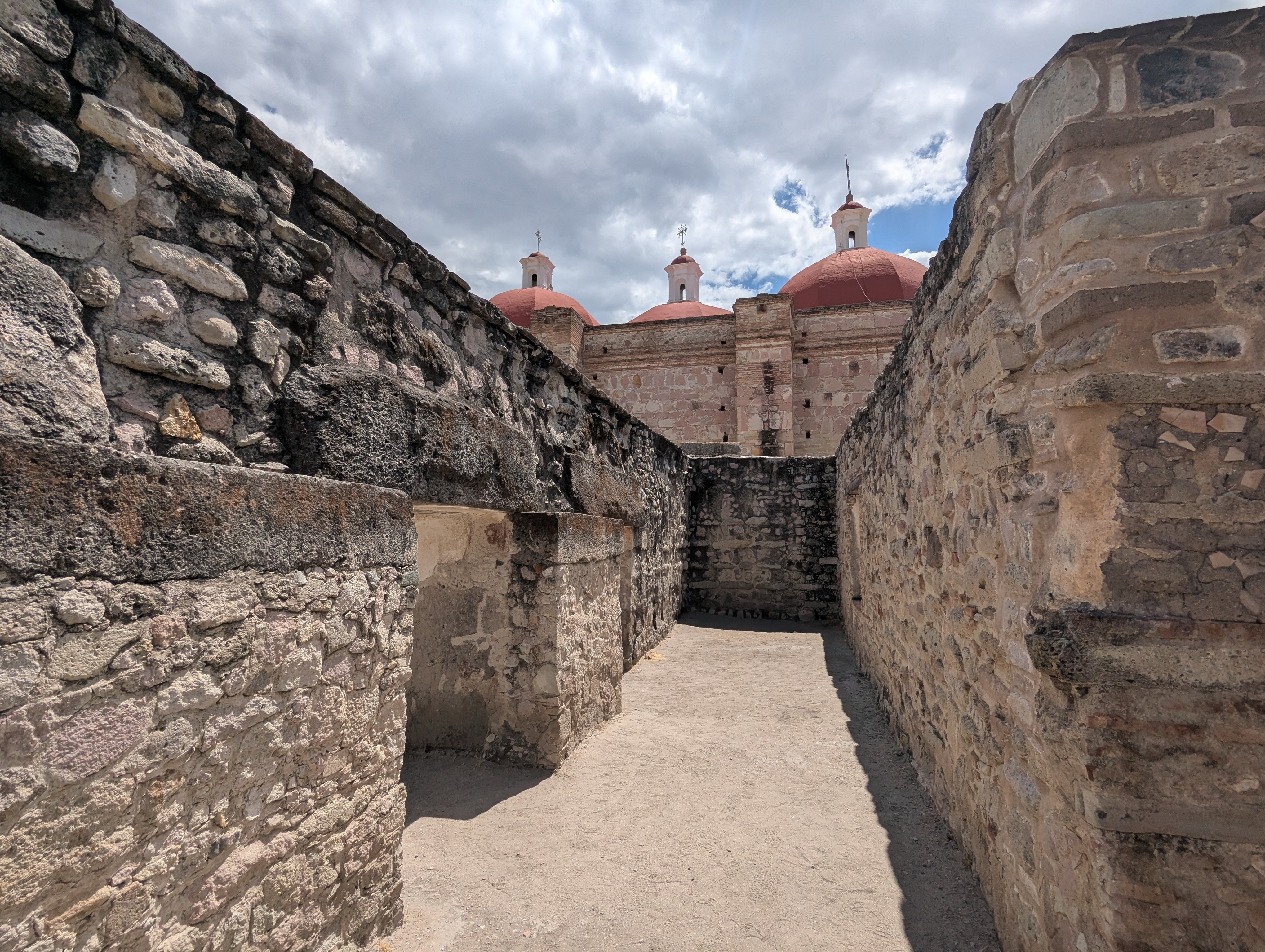
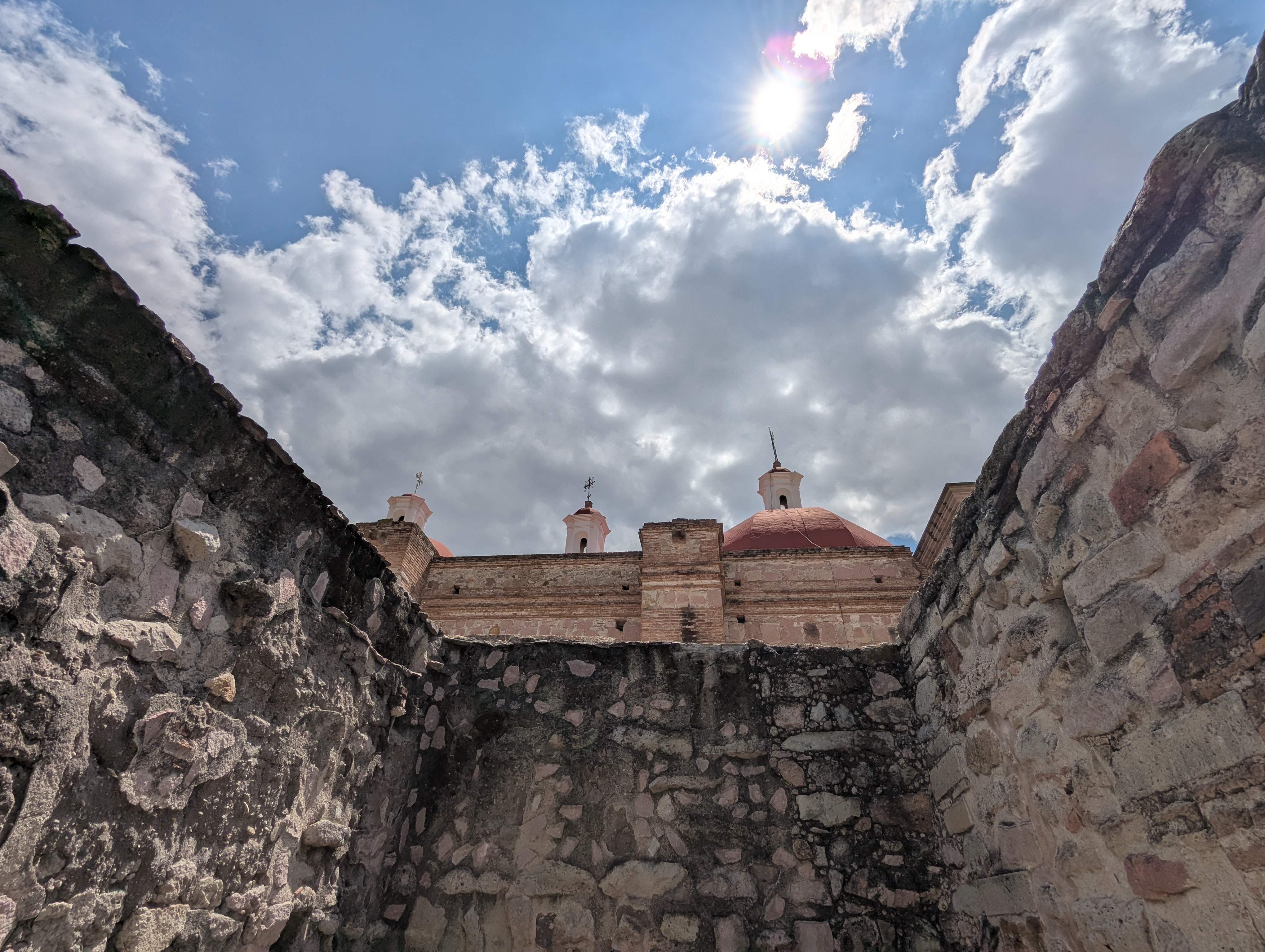
Scholars have noted that the later construction of the Church of San Pablo directly beside the pre-Hispanic ruins exemplifies the colonial practice of architectural superimposition, in which Indigenous sacred sites were appropriated and re-signified within Christian spatial frameworks, producing what can be understood as a layered or palimpsestic landscape (Kubler 1985; Boone 2000).
More recent interdisciplinary work has expanded the interpretation of Mitla beyond archaeology to include material culture, craft traditions, and contemporary Indigenous practice. Studies of Zapotec weaving in the Tlacolula Valley demonstrate that the geometric vocabulary of Mitla’s grecas persists in textile design, particularly in the wool rugs produced in Teotitlán del Valle and neighboring communities (Chibnik 2003; Wood 2008). Scholars have argued that these motifs should not be understood as simple survivals but as active continuities, in which artisans adapt inherited forms to new materials, markets, and historical conditions while maintaining their symbolic associations with place and identity (Stephen 2005). The introduction of sheep, wool, and the treadle loom during the colonial period transformed textile production, yet Indigenous weavers incorporated these technologies into preexisting visual systems, allowing architectural patterns to migrate into woven surfaces (O’Connell 2021).
Within the broader field of material culture studies, such continuities have been interpreted as evidence that design operates as a form of knowledge transmitted across generations through practice rather than text (Miller 1987; Ingold 2013). From this perspective, the grecas of Mitla can be understood not only as archaeological ornament but as part of an enduring intellectual tradition in which geometry, craft, and cosmology remain interconnected. Recent scholarship on Indigenous aesthetics similarly emphasizes that pattern, repetition, and abstraction function as vehicles of cultural memory, enabling visual forms to survive even when political and religious systems change (Phillips and Steiner 1999; Joyce 2010).
Taken together, this corpus of literature frames Mitla as more than a Postclassic ceremonial centre: it is a site in which architecture, ritual, colonial history, and contemporary craft intersect. The grecas, whether carved in stone or woven in wool, exemplify the persistence of a visual language that has endured across Zapotec, Mixtec, and colonial contexts, supporting the interpretation of Mitla as a cultural palimpsest in which successive historical layers remain visible within the same material and symbolic landscape.
Colonial sources describe Mitla as a sacred place where Zapotec high priests resided and where the dead, particularly rulers and elites, were interred in elaborate subterranean tombs. These accounts align with the architectural layout of the site, in which palace-like structures are built over cruciform burial chambers, reinforcing the idea that the living and the dead occupied the same sacred space.
Following the Spanish conquest in the sixteenth century, Mitla was partially dismantled, and stones from the pre-Hispanic buildings were reused in the construction of the Church of San Pablo, which still stands beside the ancient ruins. This act of architectural superimposition was not unusual in colonial Oaxaca, but at Mitla it is especially striking, as the Christian church rises directly beside the geometric walls of the Zapotec ceremonial complex, visually marking the transition from Indigenous religious authority to colonial rule. Despite this disruption, the site was never completely abandoned, and the surrounding town of San Pablo Villa de Mitla preserves cultural traditions that link the present community to the region’s pre-Hispanic past.
Recent research at Mitla has been significantly advanced by Project Lyobaa, a multidisciplinary investigation directed by Marco M. Vigato in collaboration with the Mexican National Institute of Anthropology and History (INAH), the National Autonomous University of Mexico (UNAM), and the ARX Project, which seeks to verify long-standing historical accounts describing an extensive subterranean complex beneath the site. Using non-invasive geophysical techniques (including Ground Penetrating Radar, Electrical Resistivity Tomography, and Seismic Noise Tomography) the 2022 survey produced a three-dimensional model of the subsurface architecture and confirmed the presence of large underground chambers and tunnels beneath the Church Group at Mitla, in the same area that colonial sources identified as the entrance to Lyobaa, the Zapotec underworld (Vigato 2021). The scans also revealed evidence of earlier construction phases beneath the Palace of the Columns and additional anomalies that may correspond to tombs or buried structures, suggesting that the architectural development of Mitla was more complex than previously understood and supporting ethnohistorical accounts, such as that of the seventeenth-century Dominican chronicler Francisco de Burgoa, who described a vast subterranean temple sealed during the colonial period (Vigato 2021; see also INAH reports). These findings reinforce the interpretation of Mitla as a ceremonial landscape closely associated with death, ancestry, and cosmological beliefs, while also demonstrating how new geophysical technologies are reshaping archaeological understandings of the site without the need for excavation.
The present form of Mitla can be understood as a palimpsest of successive cultural layers, in which Zapotec foundations, Mixtec interventions, and the later construction of the Spanish Catholic Church of San Pablo are physically and symbolically superimposed, creating an architectural landscape where Indigenous sacred space, postclassic political authority, and colonial religious power coexist within the same built environment.
Seen closely, the grecas feel almost modern, anticipating textile design, architecture, and even digital geometry, yet they remain deeply tied to Indigenous systems of knowledge that understood design as a form of thought. Mitla is not only an archaeological site but part of a living textile region, and the visual language of its stone walls continues in the weaving traditions of the Tlacolula Valley. Nearby towns such as Teotitlán del Valle, Santa Ana del Valle, and other Zapotec communities are internationally known for wool rugs and tapetes woven on treadle looms, many of which reproduce the same stepped fret patterns seen in the ancient palaces. These motifs, move seamlessly from architecture to textile, suggesting a continuity of design knowledge that has survived conquest, colonialism, and industrialization.
Historically, weaving in the Oaxaca Valley predates the Spanish conquest, when Indigenous artisans worked with cotton and natural dyes. The introduction of sheep, wool, and the treadle loom in the colonial period transformed the scale and technique of textile production, but it did not erase older visual traditions. Instead, Zapotec weavers adapted new materials to existing symbolic vocabularies, allowing motifs like the Mitla grecas to persist in a new medium. In this sense, the carpets produced today can be read as another layer in the long palimpsest of the region, where pre-Hispanic design, colonial technology, and contemporary cultural expression coexist.
In contemporary rugs, the greca is no longer carved in stone but translated into dyed wool, yet the structure of the pattern remains remarkably consistent: interlocking lines, stepped spirals, and repeating geometric paths that create a sense of movement across the surface. Weavers often describe these designs not simply as decoration but as inherited forms, passed down through generations, and understood as part of Zapotec and Mixteca cultural identity. The act of weaving therefore becomes more than craft production; it is a continuation of an intellectual and aesthetic system in which pattern carries memory, place, and cosmology.
In this light, the grecas at Mitla are not relics of a vanished civilization but part of a continuous visual culture. The same patterns that once marked sacred walls now appear in homes (including mine as I collect Oaxacan weavings), markets, and workshops, demonstrating how design can function as a durable form of knowledge and historical lineage.
References
Bernal, Ignacio. 1968. Ancient Mexico in Colour. London: Thames and Hudson.
Boone, Elizabeth Hill. 2000. Stories in Red and Black: Pictorial Histories of the Aztecs and Mixtecs. Austin: University of Texas Press.
Boone, Elizabeth Hill, and Walter D. Mignolo, eds. 1994. Writing Without Words: Alternative Literacies in Mesoamerica and the Andes. Durham, NC: Duke University Press.
Caso, Alfonso. 1938. Exploraciones en Oaxaca. Mexico City: Instituto Nacional de Antropología e Historia.
Chibnik, Michael. 2003. Crafting Tradition: The Making and Marketing of Oaxacan Wood Carvings. Austin: University of Texas Press.
Ingold, Tim. 2013. Making: Anthropology, Archaeology, Art and Architecture. London: Routledge.
Instituto Nacional de Antropología e Historia (INAH). n.d. “Mitla.” Lugares INAH. Accessed March 19, 2026. https://lugares.inah.gob.mx/en/node/4350.
Joyce, Rosemary A. 2010. Ancient Bodies, Ancient Lives: Sex, Gender, and Archaeology. London: Thames and Hudson.
Kubler, George. [1962] 1993. The art and architecture of ancient America: the Mexican, Maya, and Andean peoples. Yale University Press.
Kubler, George. 1985. Studies in Ancient American and European Art: The Collected Essays of George Kubler. New Haven: Yale University Press.
Marcus, Joyce. 1983. “Zapotec Religion.” In The Cloud People: Divergent Evolution of the Zapotec and Mixtec Civilizations, edited by Kent V. Flannery and Joyce Marcus, 345–372. New York: Academic Press.
Marcus, Joyce, and Kent V. Flannery. 1996. Zapotec Civilization: How Urban Society Evolved in Mexico’s Oaxaca Valley. London: Thames and Hudson.
Miller, Daniel. 1987. Material Culture and Mass Consumption. Oxford: Blackwell.
O’Connell, Mark Joseph. “Traditional weaving cultures in a global market: The case of Zapotec weavers.” International Journal of Fashion Studies 8, no. 1 (2021): 85-103.
Paddock, John. 1983. Ancient Oaxaca: Discoveries in Mexican Archaeology and History. Stanford, CA: Stanford University Press.
Phillips, Ruth B., and Christopher B. Steiner, eds. 1999. Unpacking Culture: Art and Commodity in Colonial and Postcolonial Worlds. Berkeley: University of California Press.
Spores, Ronald. 1965. The Mixtec Kings and Their People. Norman: University of Oklahoma Press.
Stephen, Lynn. 2005. Zapotec Women: Gender, Class, and Ethnicity in Globalized Oaxaca. Durham, NC: Duke University Press.
Urcid, Javier. 2001. Zapotec Hieroglyphic Writing. Washington, DC: Dumbarton Oaks Research Library and Collection.
Vigato, Marco M. 2021. “Project Lyobaa – Results from the First 2022 Season.” ARX Project. https://www.arxproject.org/projectlyobaa2022
 markoconnellstudio