
Stitching and Glitching a Digital Age: The Convergence of Fashion and Technology (2026)
Author: Dr. Mark Joseph O’Connell.
Publication Date: Sept. 15, 2026.
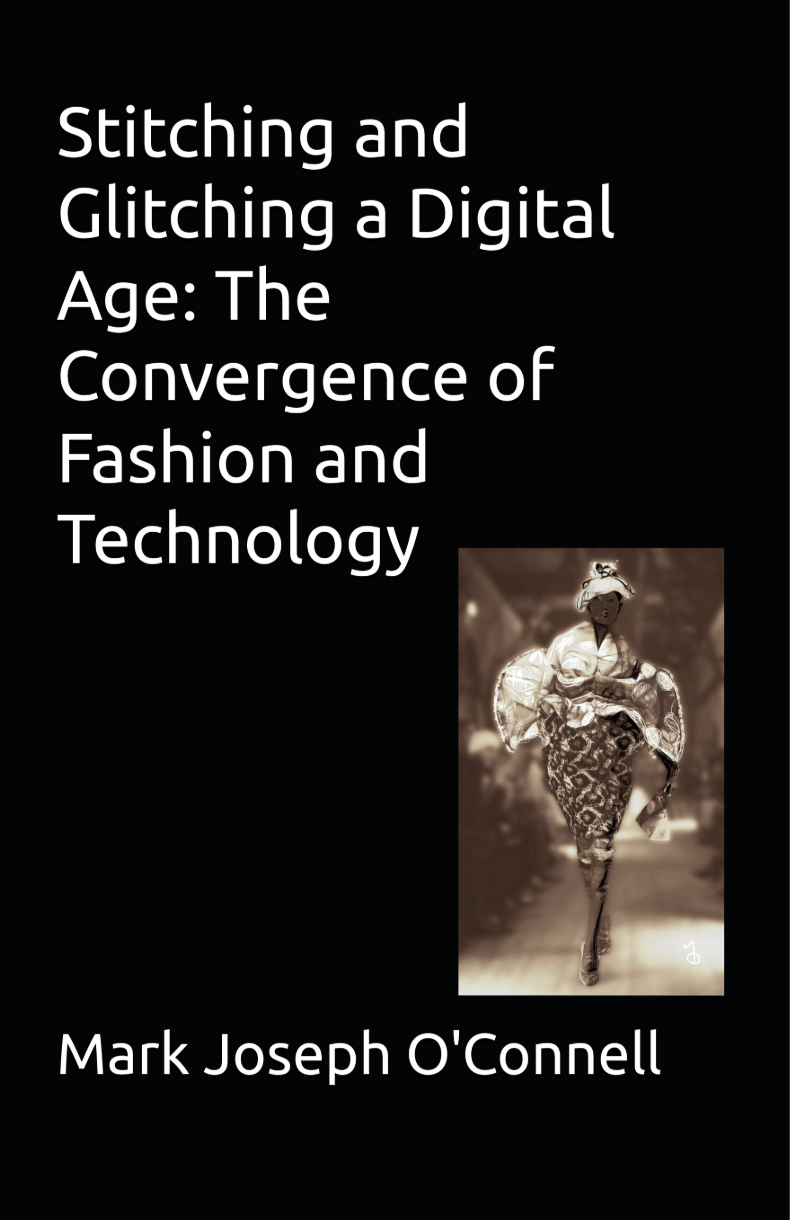
Description
Stitching and Glitching a Digital Age is a critical study of fashion technology in the digital age. It argues that fashion has never been separate from technology: from the needle, loom, sewing machine, zipper, synthetic fibre, pattern block, and body measurement chart to AI design systems, smart textiles, virtual garments, platform retail, biometric wearables, digital avatars, gamified luxury spaces, resale infrastructures, and biofabricated materials, fashion has always mediated bodies through tools, systems, images, labour, and material worlds.
The book’s central metaphor is “stitching and glitching.” Fashion stitches together fibre and flesh, body and world, labour and value, image and desire, organism and design, data and identity. Yet fashion also glitches. It misrecognizes bodies, overproduces goods, extracts labour, accelerates desire, surveils consumers, pollutes environments, repeats racial and gendered exclusions, and conceals the material cost of technological spectacle. These glitches are not merely failures. They are diagnostic openings that reveal where fashion’s promises of innovation, sustainability, inclusion, and digital freedom begin to break down. Rather than treating fashion technology as a recent novelty or a neutral sign of progress, this book reads fashion as a cultural-technical ecology. Clothing is not simply adornment, commodity, or aesthetic surface. It is an interface through which bodies become visible, measurable, desirable, governable, gendered, racialized, protected, surveilled, and sold. Contemporary fashion technologies intensify these mediations. AI does not simply “assist” fashion design; it reorganizes authorship, creativity, labour, datasets, intellectual property, and aesthetic bias. Similarly, digital fashion does not only dematerializes dress; it relocates fashion into servers, screens, avatars, platforms, energy systems, attention economies, and data infrastructures. Smart textiles not only care for the body; they may also capture it, and biofabrication does not automatically save fashion from extraction; it raises new questions about living matter, proprietary organisms, scale, labour, and ecological accountability.
The book culminates in the S.T.I.T.C.H. framework, an original ethical model for evaluating fashion technology. The framework proposes six principles: Situated Material Accountability, Transparent Data Restraint, Inclusive Embodiment, Technological Labour Justice, Circular Afterlife and Repair, and Human and More-than-Human Care. Together, these principles provide scholars, students, designers, technologists, critics, brands, and consumers with a vocabulary for distinguishing meaningful fashion innovation from technological spectacle.
Chapters
Part I: Fashion as Technology
Introduction: Stitching and Glitching Fashion Technology
The introduction establishes the book’s central argument: fashion is not newly technological, but has always been a cultural-technical system. It introduces the key metaphor of stitching and glitching, explaining fashion as both a practice of connection and a field of rupture. The chapter outlines the book’s theoretical foundations in McLuhan, Baudrillard, Braidotti, material culture, posthumanism, fashion studies, media theory, and political economy. It also positions contemporary fashion technologies: AI, avatars, smart textiles, virtual garments, biofabrication, digital retail, and surveillance systems, within older histories of needlework, mechanized stitching, sizing, synthetic fibres, advertising, spectacle, and global labour.
Chapter1 : Wearable Ecologies, Fashion, Technology, and Intelligent Matter
This chapter examines the future of fashion through intelligent matter: responsive textiles, adaptive colour, programmable form, biofabricated materials, artificial intelligence, digital product passports and regenerative systems. It argues that fashion’s most significant transformation will occur not only through silhouette, image or seasonal novelty, but through material behaviour. Drawing on posthuman theory, new materialism and fashion studies, the chapter reframes the garment as an interface between skin, atmosphere, information and ecology. Rather than treating innovation as inherently progressive, it proposes “wearable ecology” as an alternative to wearable technology, arguing that fashion’s future must be materially accountable, socially situated and ecologically responsible.
Chapter 2: The Garment-Interface: Marshall McLuhan and Fashion as Extension
This chapter develops a McLuhanian theory of fashion. Clothing is read as one of the earliest media technologies: an extension of skin, temperature regulation, bodily movement, social identity, and sensory relation. Using McLuhan’s tetrad of enhancement, obsolescence, retrieval, and reversal, the chapter examines armour, footwear, eyewear, perfume, smart textiles, and wearable sensors. It argues that every fashion technology extends the body while also producing new constraints. The garment that protects may restrict; the shoe that enhances movement may deform; the smart textile that monitors wellness may become a device of surveillance. This chapter establishes the body as the first site of fashion technology.
Chapter 3: Thingness, Aura, and the Fashion Object
This chapter turns to fashion’s status as object, artwork, commodity, relic, and fetish. Through Heidegger, Benjamin, and material culture methods, it examines how garments gather worlds around them: labour, brand value, archival authority, celebrity association, material tactility, and institutional consecration. The chapter challenges the artificial divide between fine art and fashion, arguing that both are material practices that circulate through markets, critics, collectors, archives, and publics. Fashion objects can produce aura, disclose worlds, conceal labour, and become sites of philosophical inquiry.
Chapter 4: Fashion’s Medianatures: Media Materiality, Deep Time, and the Fashion-Technology Complex
This chapter situates fashion within media geology and planetary materiality. Drawing on Jussi Parikka, Jane Bennett, Rosi Braidotti, and new materialism, it argues that digital fashion is never immaterial. Screens, platforms, servers, minerals, synthetic fibres, petrochemicals, dyes, waste streams, and atmospheres all form part of fashion’s technological ecology. The chapter links the histories of synthetic materials, digital infrastructures, and environmental harm, showing how fashion’s surfaces depend on deep material systems.
Part II: Platforms, Desire, and Digital Consumption
Chapter 5: From the Sewing Machine to Spacewear: A Short History of Fashion Technology
This historical chapter traces a continuum from needlework and mechanized sewing to synthetic fibres, ready-to-wear sizing, CAD, body scanning, wearable technology, and collaborations such as Axiom Space and Prada. It resists the idea that fashion technology begins with AI or digital fashion. Instead, it shows how every major transformation in fashion has involved tools, systems, measurements, machines, material innovations, and new arrangements of labour and the body.
Chapter 6: The Virtual Boutique: Baudrillard, Luxury E-Commerce, and Buying the Image before the Object
This chapter reads luxury e-commerce through Baudrillard’s concepts of simulacra, sign-value, and hyperreality. The online boutique is not merely a digital storefront; it is a system for producing desire before material contact. Through object analysis and autoethnographic reflection, the chapter examines how digital luxury retail turns images, scarcity, personalization, surveillance, resale value, and brand aura into a new form of mediated consumption. It asks what happens to tactility, fit, authenticity, and material knowledge when the image of the object precedes and sometimes exceeds the object itself.
Chapter 7: Watching What We Wear: Surveillance, Data, and Fashion Consumption
This chapter examines biometric garments, virtual try-on, recommendation systems, size prediction, facial recognition, retail analytics, and platform personalization. It argues that fashion is becoming one of the most intimate interfaces of data extraction because it operates at the level of the body. Measurements, gait, skin, preference, posture, purchasing behaviour, and self-image can all be captured through fashion technologies. The chapter asks how fashion’s promise of personalization may reverse into sorting, monitoring, exclusion, and consumer manipulation.
Chapter 8: Fashion Brands as Complicated Objects: Celia Lury, Hype, Value, and the Techno-Cultural Brand
Drawing on Celia Lury, this chapter reads the fashion brand as a complicated object: not a fixed identity, but a dynamic assemblage of products, images, platforms, consumers, archives, collaborations, scarcity, resale, hype, and data. It examines how brands now function as cultural technologies that organize desire and social belonging. The chapter considers brand value not simply as marketing but as a form of technological relation between object, image, platform, and public.
Chapter 9: Playing at Fashion: Gamification, Luxury Retail, and the Ludic Shift
This chapter explores gamified fashion consumption, luxury gaming collaborations, branded virtual environments, reward systems, digital collectibles, avatar skins, and platform play. It argues that fashion retail increasingly borrows from games: quests, drops, levels, badges, scarcity, play loops, and immersive worlds. Through examples such as Dior-inspired virtual environments and Gucci’s digital experiments, the chapter asks whether gamified fashion expands creative participation or intensifies consumer capture.
Part III: AI, Avatars, Abjection, and Posthuman Fashion
Chapter 10: Fashion AI after the Hype: Creativity, Commerce, Sustainability, and Trust
This chapter assesses AI in fashion beyond promotional rhetoric. It examines generative design, predictive analytics, automated styling, demand forecasting, trend prediction, synthetic models, image generation, and AI-assisted retail. The chapter argues that AI may support creativity and reduce some inefficiencies, but it may also reproduce aesthetic bias, extract from creative labour, intensify consumption, obscure authorship, and generate impossible garments detached from material accountability. The chapter asks what trust should mean in an algorithmic fashion industry.
Chapter 11: Norma Kamali, AI Avatars, Legacy Design, and the Future of Fashion
Using Norma Kamali’s digital twin and related examples, this chapter examines how designers, brands, and archives use AI avatars to extend legacy, automate expertise, and preserve stylistic intelligence. It asks whether such systems can ethically transmit design knowledge or whether they risk converting creative identity into proprietary simulation. The chapter considers authorship, mortality, intellectual property, mentorship, archive, and the uncanny persistence of designer subjectivity after digitization.
Chapter 12: From Disembodiment to Posthuman Assemblage: Braidotti, Virtual Influencers, and Digital Fashion
This chapter reads virtual influencers, avatars, digital skins, and synthetic bodies through Rosi Braidotti’s posthuman theory. It argues that digital fashion does not eliminate the body but redistributes embodiment across platforms, images, code, affect, labour, and spectatorship. The chapter asks what kinds of bodies digital fashion recognizes, which bodies it idealizes, and which forms of difference it flattens or excludes. It also examines the racialized, gendered, and ableist norms embedded in many synthetic fashion bodies.
Chapter 13: Scandal as Interface: Abject Marketing, Algorithmic Outrage, and the Ethics of Fashion Technology
This chapter expands the author’s published work on Succès de Scandale and abject marketing. It examines how fashion brands use scandal, racist tropes, Holocaust references, homophobic symbols, sacred texts, sexualized danger, and apology cycles to generate attention. In the platform age, scandal becomes an interface: outrage produces clicks, searches, comments, reposts, and data. The chapter argues that abject marketing is a fashion technology because it transforms symbolic harm into brand visibility. It distinguishes critical abjection from targeted harm and connects fashion scandal to algorithmic amplification.
Chapter 14: How Anita Clarke Built the Blogosphere: Fashion, Technology, and Canadian Digital Style
This chapter offers a historically grounded case study of Anita Clarke and the Canadian fashion blogosphere. It argues that fashion technology is not only AI, smart textiles, or digital garments, but also blogging, digital community formation, local fashion advocacy, and online archival practice. The chapter positions Clarke’s work as central to understanding how digital fashion media created new publics, new forms of authorship, and new ways of documenting Canadian style culture.
Part IV: Repair, Responsibility, and the Future of Fashion Technology
Chapter 15: Technology as Social Instruction: Ursula Franklin, Platformized Fashion Retail, and the Hidden Materialities of Digital Consumption
This chapter reads fashion platforms through Ursula Franklin’s understanding of technology as practice, system, and social instruction. It argues that platformized retail teaches consumers how to desire, browse, compare, purchase, return, and discard. The convenience of digital retail conceals infrastructures of logistics, packaging, warehouse labour, delivery systems, energy, waste, and data capture. The chapter asks what social instructions are embedded in seamless checkout, one-click purchase, free returns, and algorithmic recommendation.
Chapter 16: Fashion after Nature: Technology, Transparency, and the Problem of Repair
This chapter examines sustainability, circularity, repair, resale, recycling, biomaterials, and transparency claims. It argues that a circular fashion system cannot be declared at the level of fibre alone. It must be proven across the full life of the object: design, production, use, repair, collection, sorting, recycling, redistribution, and end-of-life. The chapter critiques superficial sustainability and asks how fashion technology might support repair rather than accelerate replacement.
Chapter 17: CHAPTER: Fashion’s Medianatures: Media Materiality, Deep Time and the Fashion-Technology Complex
This chapter develops a Parikka-inspired theory of fashion technology as medianature, arguing that garments, fibres, platforms, sensors, bodies, labour, infrastructures and waste are materially and ecologically co-constituted. Through examples including Kantamanto Market, the Atacama clothing dump, fibre mislabelling, AI design, smart textiles and digital fashion. Ultimately, the chapter proposes a medianatural fashion ethics that evaluates fashion technologies not by novelty or seamlessness, but by what they extract, obscure, sustain, discard and make possible.
Chapter 18: Restitching the Future: The S.T.I.T.C.H. Framework for Fashion Technology Ethics
The concluding chapter presents the book’s original ethical framework. S.T.I.T.C.H. stands for Situated Material Accountability, Transparent Data Restraint, Inclusive Embodiment, Technological Labour Justice, Circular Afterlife and Repair, and Human and More-than-Human Care. The framework asks designers, brands, technologists, scholars, and consumers to evaluate fashion technology not by how futuristic it appears, but by how responsibly it relates. The book concludes that fashion’s future will not be ethical because it is smart, digital, virtual, biological, immersive, or artificially intelligent. It will become ethical only if these systems are accountable to the bodies they touch, the workers they depend on, the data they gather, the materials they mobilize, the organisms they recruit, and the worlds they leave behind.
Bio
Dr. Mark Joseph O’Connell is a professor of fashion studies at Seneca Polytechnic in Toronto whose research examines visual culture, political economy, identity, commerce, colonization, sexuality, technology, and power within fashion history. This lecture is drawn from his forthcoming book Stitching and Glitching a Digital Age: The Convergence of Fashion and Technology, to be published in Toronto by markoconnellstudio in September 2026, which argues that fashion has always been a cultural-technical system linking bodies, images, labour, desire, value, and social worlds. O’Connell is the author of Canadian Fashion Economies and the Lilac Time at the Rodeo books, has published widely in leading fashion studies journals, and works across scholarship, fiction, art, and design, with current work at markoconnellstudio.com.
Why This Book Now?
Fashion technology is too often introduced through the seductive language of novelty. AI-generated collections, virtual garments, wearable sensors, biometric textiles, digital twins, immersive retail, NFTs, and lab-grown materials are presented as evidence of an inevitable technological future, as though fashion were only now becoming technological. This book challenges that assumption. Fashion has always been technological: it has always mediated the body, organized labour, shaped desire, structured visibility, and materialized social relations. The more urgent question is not whether fashion will become technological, but what kinds of technological fashion systems are being built, whose interests they serve, whose bodies they recognize, whose labour they obscure, what forms of data they extract, what materials they mobilize, and what futures they make possible or foreclose.
At the centre of this book is a rethinking of fashion itself as one of the earliest and most intimate media technologies. Drawing on Marshall McLuhan’s understanding of media as extensions of the body, clothing is approached not as passive surface or decorative supplement, but as interface. Garments extend skin, regulate temperature, frame movement, alter posture, shape perception, carry memory, and signal social identity. They make bodies legible, desirable, disciplined, protected, exposed, included, or excluded. In contemporary fashion systems, this mediating function has intensified: clothing and fashion images now increasingly interact with sensors, platforms, datasets, algorithms, avatars, and immersive environments. The garment becomes not only something worn, but something that communicates, tracks, predicts, circulates, and computes.
The book also insists that digital fashion must be understood through materiality rather than through fantasies of immaterial escape. Virtual garments, AI images, avatars, online boutiques, gamified retail spaces, NFTs, and platform-based fashion economies are often described as weightless, frictionless, and sustainable by default. Yet they depend on highly material infrastructures: devices, servers, rare earth minerals, energy systems, logistics networks, platform governance, image datasets, content moderation, data labour, and the constant capture of consumer attention. Digital fashion may reduce some forms of physical production and waste, but it also produces new regimes of extraction, surveillance, symbolic consumption, and environmental cost. Its apparent immateriality is itself a technological illusion, one that conceals the infrastructures and inequalities that make digital fashion possible. Fashion technology must therefore be read within the longer histories that have always structured fashion: histories of labour, identity, gender, sexuality, abjection, spectacle, and social control.
Rather than ending with critique alone, the book develops a constructive ethical framework for assessing fashion technologies from design to afterlife. S.T.I.T.C.H. offers a practical critical model for asking how technological fashion redistributes power, visibility, risk, labour, matter, and possibility. It resists both techno-utopian celebration and techno-pessimistic rejection. AI, smart textiles, digital fashion, biofabrication, and immersive retail are not treated as inherently liberatory or inherently harmful. Instead, the book asks how they are designed, by whom, for whom, under what conditions, with what infrastructures, and at what cost. Its aim is to move beyond the spectacle of innovation and toward a more accountable understanding of fashion technology as a field of ethical, political, material, and imaginative struggle.
Sample Chapters
Chapter 1: Wearable Ecologies, Fashion, Technology, and Intelligent Matter
Chapter Abstract
This chapter examines the future of fashion through the emergence of intelligent matter: responsive textiles, adaptive colour, programmable form, biofabricated materials, artificial intelligence, digital product passports and regenerative systems. It argues that fashion’s most significant transformation will not occur only at the level of silhouette, image or seasonal novelty, but at the level of material behaviour. Colour, material and finish are shifting from passive aesthetic attributes into active systems that can sense, respond, disclose, repair, biodegrade, regulate, authenticate and communicate across bodies, environments, data infrastructures and waste streams. Drawing on posthuman theory, new materialism and fashion studies, the chapter reframes the garment as a situated interface between skin, atmosphere, information and ecology. Rather than celebrating technological innovation as inherently progressive, it asks what responsibilities emerge when matter becomes intelligent. Through discussions of sensory textiles, structural colour, symbiotic skins, pollution-derived materials, AI-assisted design and the ethics of endings, the chapter proposes “wearable ecology” as an alternative to conventional wearable technology. In this model, garments are judged not by novelty or responsiveness alone, but by the relations they make visible, the harms they reduce and the forms of care they enable. Ultimately, the chapter argues that the future of fashion is not simply smart, seamless or technologically enhanced, but materially accountable, socially situated and ecologically responsible.
Keywords:
fashion futures; intelligent matter; wearable ecology; adaptive CMF; responsive textiles; artificial intelligence; posthuman fashion; new materialism; regenerative design; biofabrication; digital product passports; circular fashion; Karen Barad; Rosi Braidotti; Donna Haraway; Anneke Smelik; Jean Baudrillard; Juhani Pallasmaa; Sara Ahmed.
Lecture from Chapter 1:
FURTHER FASHION & TECHNOLOGY RESEARCH BY DR. MARK JOSEPH O’CONNELL
Parts of this book have grown from a long-running body of research on fashion, technology, material culture, identity, sustainability, colonialism, queer visual culture, pedagogy and the politics of dress. Some chapters draw on, revise, extend or recontextualize arguments first developed in my earlier books, peer-reviewed articles, book chapters, conference presentations, lectures and research residencies. In each case, the material has been substantially reworked for this volume so that it participates in the book’s larger argument about fashion as a technological, cultural, economic and ethical system.
Several chapters are informed by my previous monograph Canadian Fashion Economies: A Select History of Fashion Culture, Commerce, and Colonization (Bloomsbury 2025). These works provide important foundations for the book’s discussions of fashion economies, colonial structures, visual culture and the relationship between dress, commerce and social memory.
https://www.bloomsbury.com/ca/canadian-fashion-economies-9781350357365
The book also draws on earlier chapter-length work, including “Technology as Social Instruction: Ursula Franklin and the Dematerialized Fashion Marketplace,” published in What Would Ursula Franklin Say?, edited by Kanishka Sikri, Katie Mackinnon and Leslie Regan Shade, and “Two Way Street: Transnational Fashion Education as a Model for Equity and Sustainability,” published in the proceedings of the Fourth International Conference on Asian Studies. These earlier studies helped shape the present book’s attention to fashion pedagogy, technological mediation, social instruction, sustainability and the ethical responsibilities of design education.
A number of the chapters also develop material from my peer-reviewed articles and reviews, including work published or forthcoming in TEXTILE: Cloth and Culture, Fashion Theory, Critical Studies in Men’s Fashion, Fashion, Style & Popular Culture, Luxury Studies: The In Pursuit of Luxury Journal, The International Journal of Fashion Studies, Queer Studies in Media & Popular Culture, The Journal of Design, Business & Society and Fashion Studies. Across this book, these earlier arguments are brought into new relation with fashion technology, platform capitalism, digital fashion, AI, surveillance, posthuman theory and design ethics. Some of the research also emerged through conference presentations, symposia and invited talks delivered in Canada, the United States, the United Kingdom, Italy and Mexico. These include presentations at the Fashion Institute of Technology, the Apparel Affinity Group Annual Conference, the Canadian Communication Association Congress, the In Pursuit of Luxury Conference at Politecnico di Milano, the Sartorial Society Series, Coventry University, Cardiff University, Drexel University, the Royal Ontario Museum, York University, Ryerson University, LIM College, Massey College, and the Fourth International Conference on Asian Studies. Presenting this work in scholarly and professional contexts allowed many of the ideas in this book to be tested, challenged, refined and expanded through dialogue with colleagues, students, curators, designers and researchers.
The book is also indebted to research residencies and professional engagements at institutions including the Royal Ontario Museum in Toronto, the Fashion Institute of Technology in New York, the American Museum of Natural History in New York, Universidad del Arte in Mexico, Universidad Iberoamericana in Mexico City and Puebla, and the Design Exchange in Toronto. These residencies and lectures provided opportunities to study garments, textiles, archival materials, Indigenous regalia, fashion collections, designers lost to AIDS, sustainable design practices, Canadian fashion histories and the relationship between fashion objects and institutional memory.
Because this book gathers research produced across many years, disciplines and contexts, it should be understood not as a simple compilation of previously published work, but as a restitching of that work into a new critical framework. Earlier studies of fashion archives, queer fashion histories, Indigenous textile practices, sustainability, luxury, pedagogy, dematerialized fashion consumption and colonial trade systems are placed here in conversation with newer questions about artificial intelligence, digital fashion, algorithmic retail, virtual garments, surveillance, posthuman embodiment and fashion technology ethics. Where previously published or presented material appears, it has been revised, expanded and reframed to serve the argument of this book. The chapters that follow are therefore indebted to these earlier publications and presentations, but they also move beyond them. They gather the seams of prior research into a broader inquiry: how fashion technologies stitch bodies, images, labour, materials, data, environments and identities together, and how their glitches reveal the ethical work still to be done.
Simulacra in Silk: Haraway’s Cyborg, Performative “Femininity” and the Aesthetics of the Automaton on the Margiela Runway
O’Connell, M. J. (2026). Simulacra in Silk: Haraway’s Cyborg, Performative “Femininity”, and the Aesthetics of the Automaton on the Margiela Runway. Fashion Theory, 1–36.
https://www.tandfonline.com/doi/full/10.1080/1362704X.2026.2614117
This article reimagines the representation of “female” robots through the lens of fashion, exploring how the female-coded machine moves from fantasy object to theoretical agent. Anchoring the discussion in the Maison Margiela Artisanal 2024 show by John Galliano, where models emerged as porcelain-faced, sculpturally swathed automatons, it argues that fashion can be a powerful site for re-performing gender and identity. Drawing on Donna Haraway’s cyborg feminism, Judith Butler’s gender performativity, and Jean Baudrillard’s concept of simulacra, the article reinterprets iconic robotic figures from Metropolis, Blade Runner, and The Stepford Wives in comparative dialogue with Galliano’s live fashion theater. Rather than depicting women as programmable objects of desire, Galliano’s show performs gender as glitched: looped, over-coded, and unraveling. The garments mimic corrugated paper, retro silhouettes, and abraded lace, exposing the costume of femininity as artifice. The Margiela cyborgs walk not to seduce but to disturb, spectral remnants of a gender system collapsing under the weight of its own signs. Ultimately, this article proposes that the runway, like the screen, is a hyperreal stage for resisting visual regimes of conformity, and that the cyborg, far from being futuristic, is already here, dressed in porcelain and theatrical distortion, and moving (staggering) deliberately off-script.
The Role of Open AI in Fashion: Transforming Creativity Through Innovation?
- August 2024
The integration of Artificial Intelligence (AI) into fashion design is transforming the industry by introducing tools that enhance creativity and efficiency. AI systems, particularly generative AI, enable designers to generate unique patterns, styles, and predict fashion trends by analyzing vast datasets, thereby enriching the creative process with new aesthetics and experimentation with unconventional materials. This article explores the growing influence of generative AI across various domains, including creative arts, fashion, education, business management, and software development. In business management, AI optimizes operations, automates tasks, and supports decision-making. Additionally, AI streamlines design processes, enabling real-time customization, sustainable fashion practices, and virtual try-ons, thus revolutionizing customer experiences. In the realm of fashion education, AI offers the potential to personalize learning experiences and fosters collaboration among students. This article also provides a literature review of current academic research in fashion AI and addresses the ethical considerations of AI adoption. The conclusion emphasizes the need for responsible innovation, as the full long-term impacts of this nascent technology which offers so much potential are still largely unknown.
The Quadruple Helix in Fashion Paradigms: Bridging Innovation, Sustainability, and Societal Impact for a Regenerative Future
- February 2025
This research explores the transformative potential of the Quadruple Helix model within fashion education, expanding upon the traditional Triple Helix framework by integrating civil society and environmental sustainability as critical drivers of innovation. While the Triple Helix model emphasizes the interplay between academia, industry, and government, the Quadruple Helix adds a vital dimension that addresses the fashion industry’s environmental impact, labour ethics, and the need for systemic change. Given fashion’s role as one of the most resource-intensive and polluting industries globally, this model fosters interdisciplinary collaboration among educational institutions, policymakers, industry leaders, and sustainability advocates to promote ethical production, circular economy principles, and policy-driven solutions. Through case studies and theoretical analysis, this article demonstrates how fashion education can evolve from focusing solely on design aesthetics to becoming a catalyst for sustainable innovation. By embedding sustainability into curricula, research, and industry partnerships, the Quadruple Helix offers a comprehensive framework for shaping future leaders committed to ethical and environmentally responsible practices within the fashion ecosystem.

