
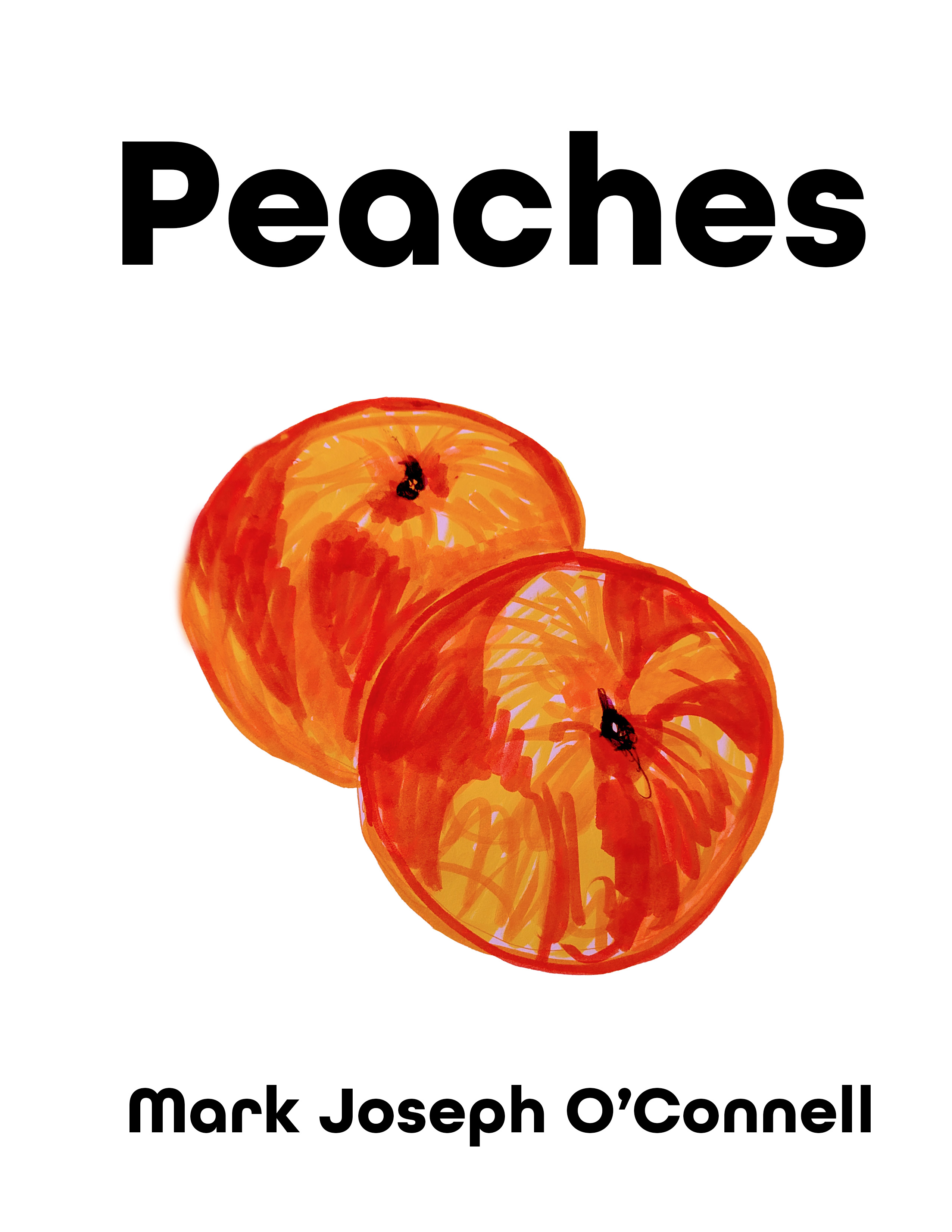
Fantastic news! Peaches the novel has been published and can be ordered here,
Canadian orders here:
I hope you enjoy the book, I loved writing an alternative Queer history for some of my favorite musical genres! XOMark ❤️
On Play:
https://play.google.com/store/books/details?id=w_r_EQAAQBAJ
CHAPTER 1: They’d Be Fools Not to See (2025)
Some Songs Just Do Not Belong in Beer Commercials (2025)
Chatham, Ontario, 2025
“Tender Peaches in the summertime…
So juicy, so ripe…
…”
The melody floated through the living room, curling into the air like Trida’s cigarette smoke. From her place on the couch, she exhaled a slow stream, watching the screen with a grimace: “Your uncle is not going to like this…” she declared, shaking her head. The boy glanced back at her, confused: “Why not mama?”
Trida tapped the ash off into a ceramic dish shaped like a pink French poodle, took a drag, lips curling into something between amusement and resignation: “Because he wrote that song about something very different…”
She jabbed toward the screen with her cigarette: “Not about beer and pretty Straight kids jumping into the lake.” The commercial faded to black, replaced by the bright, sterile cheerfulness of a fast-food ad. The song, however, still hung in the air, even after the screen had moved on. The boy turned back to the TV, but Trida was still watching the screen, shook her head slightly as she muttered to herself: “It would have killed them to cast a Black model?”
Salt Spring Island, British Columbia, 2025
Tommy dialed with a mix of dread and inevitability, the image of the beer commercial still grating his psyche like a paper cut.
From the cedar-wrapped balcony of the house nestled high above the eastern cliffs, Salt Spring [ĆUÁN] Island stretched out beneath him in folds of moss-draped firs and tide-washed stone, the trees bending just slightly as if in constant deference to the wind. Beyond the clustered pines, the ocean shimmered, slate-blue and dappled with silver where the sun caught the moving tide.
Gulls traced long arcs above the bay, silent against the hush of afternoon, while a lone sailboat drifted toward Ganges Harbour, its white canvas taut with purpose.
Marty answered, voice was bright, careless: “Greetings from Berlin. If it isn’t the ghost of Christmas royalties.”
But Tommy’s tone shut down the pleasantries: “You sold that song?” A pause, then Marty’s casual deflection: “Which one?”
Tommy didn’t bite, “Which one? Oh please, my demo version of ‘Tender Peaches.’ I just watched it push a summer lager on TV, kids jumping into lakes, like it’s the damn Summer of Love…rebooted for an American brewery.”
Marty chuckled, unfazed: “Ah, that finally dropped. Retro Gold cleaned up your mix. Sounds good, right?”
Tommy’s breath went still: “You had to license that version?” Marty, still casual, reminded him: “They own the catalogue, Tommo. You signed the clause, page forty-seven, just above where Clayton spilled the espresso at the Laurentian Grand.”
Tommy’s fingers clenched the receiver: “They didn’t write that song. We did, me, Jessa…Luca.”
Marty’s voice cooled, edged with defensiveness: “And Retro Gold owns it. We were broke kids, and that was the only deal on the table.”
Tommy’s voice dropped to a hard whisper: “Jessa wrote the bridge.”
“She mumbled the bridge,” Marty countered: “I rescued it and kept it intact…you’re welcome. Jessa left, like she always left. We kept on playing. You think she wanted credit on the master when she wouldn’t even show up for the overdub session?” The silence between them crackled.
“They wanted Peaches,” Marty pressed, “Not ‘Cold Morning Light,’ not ‘Harbour Lights.’ Peaches is the one they remember. They wanted a folky version, and your demo was the perfect fit.”
Tommy stifled a bitter laugh: “Because it’s simple, because it sounds like summer…they think it’s about fruit.”
Marty said nothing, then: “Look, songs grow up. You don’t get to keep them locked up in the attic forever.”
Tommy shot back: “You also don’t need to drown them in the lake in idiot beer commercials.”
Marty sighed, quieter now: “Clayton said the same thing last week. Still thinks we can live on integrity and sunshine.”
“At least he remembers what it cost to make it!”
Marty replied, tired: “You watched me negotiate and then you signed that deal and said nothing. It made us.”
Tommy looked out the window: “I said nothing, because I was trying not to lose everything.”
“Too late my friend…” Then, Marty brightened up: “Hey, you will never guess who I ran into in Kollwitzplatz…”
(To be continued…)
Long-Distance Reverie, Montreal, February 1974
Tommy had left home at seventeen. Montreal had eventually taken him in, fed him poetry and music, and kept him loved up, bruised at times but always inspired. On some nights, however, in the quiet of his apartment, he still felt like a visitor. He scribbled in a schoolboy workbook:
“Ghosts in the mirror, dust in the air
Footsteps echo down the hall
I call your name but no one answers
Guess I never belonged here at all…”
Tommy set the guitar down, rubbing his eyes. The radiator clicked as it struggled against the cold, the wind outside rattling the windowpane. Somewhere in the night, in a café or a street corner or a place he hadn’t found yet, Luca was out there, drifting like a melody that refused to be caught. He reached for his pen again. The song wasn’t finished, so, neither was he.
The phone sat on the small table beside the window, an old black Bakelite rotary model with a twisted, tangled cord. It had been left behind by the last tenant, the kind of relic that no one thought to replace because it still worked, even if it was ugly, crackled and cut in and out when the wind blew.
Tommy dialed the number from memory sticking his pen in the dial slots, leaning against the window frame as the cold glass pressed against his temple. It rang twice before she answered.
“Hello, Beatty residence?” Her voice was the same as always: practical, a little tired, carrying the weight of someone who had spent a lifetime making sure things got done: “Hey, Aunt Mary!” A pause, he could almost hear her eyes narrowing: “Tommy?”
“Yeah, it’s me.” He played with the phone cord, wrapping it around his fingers, and used his breath to fog up parts of the window.
“Well, I’ll be darned. You remember you have a family.”
He chuckled, even though he knew there was some truth in the jab. He hadn’t called in too long.
Touring his solo act Maplewood, rehearsals, recording…things that felt all-consuming until he was back in his apartment with only his guitar and the hum of the city to keep him company. That’s when the past crept back and plunked down beside him and observed him like a yearling puppy.
“Yeah, yeah. I know. I meant to call.”
“Uh-huh. And pigs meant to fly.” She sighed, but it was softer this time: “How are you, Thomas?”
She was the only one who still called him that, everyone else had long since adopted Tommy Beat, the name that sounded more like a musician, more like someone worth remembering. But to her, he was her Thomas.
“I’m alright, cold as hell up here, but that’s Montreal for you. I had a big show last week. People actually showed up!”
“Course they did,” she said, matter-of-factly: “They’d be fools not to! Your little sister said she saw a poster with your face on it down in the city. Said you looked like some rock star now. Are you dressing all funny?”
“Define ‘funny’.”
“You tell me baye…”
He looked down at himself: frayed jeans, a wool sweater with a hole near the cuff, scuffed boots he’d worn for too many winters. The only thing remotely rock-star about him was a lean and sexy leather jacket hanging over the chair. A gift from Luca, who was all style, and said he needed to look the part even if he didn’t feel it.
“Nothing too crazy,” he said: “I haven’t gone full Bowie yet.”
She scoffed: “Heaven forbid…whatever that is.” But there was no real judgment in her voice. She never truly understood his music, but she never tried to stop him either; If anything, she had known this was coming long before he did.
“You remember when I used to sit by the record player for hours?” he asked, his voice quieter now: “When Trida brought home all those albums? Gordon Lightfoot, Joni Mitchell, even a David Bowie record…what was it?” He asked himself “Hunky Dory?”
“How should I know? That Lightfoot fella I liked.” she said and crooned: “I would be happy just to hold the hands I love…On this winter night with you”, her voice was as pretty as ever. Then she said, softer: “You’d sit there, humming along, writing in that little notebook of yours. I used to think you’d grow out of it. Thought you’d end up like your mother used to, working with your hands.”
“Guess I do, in a way, just with a guitar instead of a sewing machine.”
“Your mother never understood it, but me?” She sighed again, this time not out of exasperation, but something closer to nostalgia: “I always knew you’d go. You had that look in your eye, even when you were a little boy. Like you were always halfway out the door, even when you were sitting still.” That hit somewhere deep. He swallowed, shifting against the cold windowpane.
“I don’t know, Aunt Mary. Sometimes I wonder if I made the right choice.”
“And what would you be doing if you stayed? Still writing your little poems in those old ledger books, dreaming about the life you’re living now?”
“Maybe,” he admitted: “Maybe I’d be happier, though.” She was silent for a long moment. Then: “Are you not happy, Thomas?”
He hesitated, outside, laughter rising from the bar down the block, wind slipping through the alleyways. Inside, his guitar sat against the chair, the unfinished song still waiting for him.
He thought of Luca, a fire that burned too bright, always slipping through his fingers, always reaching for something just out of reach: “I don’t know,” he finally said: “Some days, yeah. Some days, it feels like everything I ever wanted. Other days, it feels like I’m chasing something that keeps moving further away.”
“Well,” she said, “that’s life, ain’t it?” He smiled, even though she couldn’t see it.
“Yeah, Aunt Mary. I guess it is.” She sighed again, the sound of an aunt who had already made peace with the fact that her nephew belonged to the road: “You eating enough?”
“Yes.”
“Liar.”
“Maybe a little.”
“You need money?”
He laughed…“Maybe a little.”
“Ok, I’ll send you some. You better take care of yourself, Thomas. And call me more often, would you? Before you start thinking you’re too important for your old auntie.”
“Never.”
“Alright then. I love you.”
“Love you too, Aunt Mary.”
The line clicked dead, Tommy sat there for a moment, the phone still in his hand, staring at the unfinished lyrics on the page, he picked up his pen again, running down the ideas that were shooting ahead of him in his mind.
“Four flights up and the air grows thin
Smell of rain creeping in through the door
Records stacked like old love letters
Scattered on the hardwood floor
Climbing up, climbing down
City lights hum like a reverie
I left my name in the cracks of this town
But it never really belonged to me
They’d be fools not to see…
The Night Tommy Met Luca (Three Months Prior) Montreal, November (1972)
The air inside Le Serpent Rouge was thick with cigarette smoke, spiced wine, and the lingering musk of rain-soaked coats. The small, dimly lit café was packed that night…artists, poets, drifters, and dreamers crammed into every available space, their faces glowing amber in the flickering candlelight.The air inside Le Serpent Rouge was thick with cigarette smoke, spiced wine, and the lingering musk of rain-soaked coats. The small, dimly lit café was packed that night…artists, poets, drifters, and dreamers crammed into every available space, their faces glowing amber in the flickering candlelight. Tommy Beat was hot, an early bootleg from one of Beat’s early 1970’s Montreal club gigs gained some traction on the college radio circuit but was shut out of mainstream airplay because of the obvious Queer coding.
Then Luca entered.
They wore a tawny plaid ensemble that blurred the line between androgynous bohemia and careful costume. A mid-calf cape, woven in deep rusts and chestnuts, cascaded over their shoulders, edged in thick black fringe that swayed like quiet punctuation marks with every step. The pattern was classic tartan but softened by age, like something rescued from an attic trunk and repurposed as art. Beneath the cape, cropped knickerbockers that bloused at the knee in a matching plaid hinted at structure but left room for movement. The fabric caught the light just enough to reveal its weight: warm, woolen, necessary. Their arms moved freely beneath the draped garment, only rarely revealing a long swinging pendant. Their hair, a wild, unbrushed corona of chestnut curls, softened the bold silhouette. It framed a face partially hidden, bowed forward in motion.
It was the boots, however, that drew the eye, rich mahogany patent leather, knee-high and sharply heeled. They reflected the light like wet leaves or lacquered wood. Luca’s hands, elegant and ringless, adjusted the fold of one boot.
The stage wasn’t much, just a raised wooden platform, barely large enough to hold a mic stand and a single stool. Tommy Beat didn’t need more than that. He stood at the mic, mid-song, utterly radiant. His black jacket hung open, revealing a bare chest adorned with layered necklaces that swayed with every note. His long curly blonde hair tumbled over his shoulders, air, catching in the glow of a neon beer sign behind him. His fingers moved like ghosts over the strings of his battered acoustic guitar, a well-worn Martin D-28, its wood darkened from years of restless hands. The melody curled into the air, something delicate, something aching. He sang:
“In the forest’s heart
Underneath the moon’s glowing hue
Silent whispers
A love that’s true
Roots entwined like old-time lovers
Holding close what the world uncovers.”
Luca seated themselves at a small corner table, and leaned forward, a cigarette smoldering between their fingers. Tommy’s eyes were closed, head tilted back, lost in the song. He did not notice Luca, not yet. Did not see the way they were staring, utterly captivated. But when the song ended…when the last note hung in the air like the final echo of something sacred…he opened his eyes, and they met Luca’s across the crowded room.
Final Set, Montreal, November 1972
After his final set, closing with his folk ditty singalong “Lonely Little Apple” that was burning up the college radio stations. (and the bar that night). Tommy sat at the far end of the bar. The counter still bore the rings of a thousand glasses, some overlapping like the growth of tree rings. Someone clapped Tommy on the shoulder gently as they passed, another leaned in briefly “That was really something, man.” He nodded, not quite meeting their eyes. He was still inside his songs, that odd, empty room left behind when you’ve said so much aloud, that was kept silent for too long.
The conversations rekindled around him, someone in the back quoting Rilke in French, a woman arguing over a chessboard, but he wasn’t inside them, he was inside himself, vulnerable. He did not see Luca approach. Only heard the clink of a glass being set beside his, then, the voice: “That wasn’t just a song.” Tommy turned, the androgyny wasn’t striking, it was seamless.
He replied: “No?”
They did not look at him when they spoke: “No, it was a door to a very solitary kingdom.”
Tommy glanced down at his glass, then up again: “It was ?” but he knew it was true.
They smiled faintly. Tommy shifted his beer, and their shoulders nearly touched, but not quite.
“Do you live around here?” he tried. They gave a small shrug: “Near enough to walk…”
He waited for more, nothing came. The bartender brought another glass of wine, unbidden, set it between them. The wine glass caught the candlelight and threw it sideways across Luca’s face. Their beautiful eyes were dark, not just in colour, but in focus, taking him in the way one studies an unfinished painting. They leaned in slightly: “It didn’t end where it should have, though.” they said: “That last line? That was the beginning.”
He exhaled, half laugh, half something else: “Is that so?”
“Yep.”
“What’s your name?” They didn’t answer right away. Instead looked toward the stage, now empty, planks of wood in need of sanding; then: “You can call me Luca…today.”
He nodded, Luca turned slightly more toward Tommy then, pulling back that thicket of curly black hair, finally allowing Tommy to get a good look at that face.
Luca had one of those faces that made one pause. Not because it was conventionally beautiful, though undeniably it was, but because it carried something else, something beneath the skin. They looked as if they had emerged from a Renaissance portrait of a Florentine noblewoman on her marriage day…Anne Ditchburn by way of La Gioconda.
“I already know your name…Tommy Beat.”
Coffee and Snow, Montreal, November 1972
Outside, the cold was immediate. Tommy shoved his hands deep into his coat pockets. The lining was torn on the right side, and his fingers worried the frayed thread absently. Beside him, Luca walked with one hand gloved, the other bare and holding a small paper cup of coffee they were sipping.
They turned down a quieter street, the city folding in around them like a worn coat. Overhead, through the haze of low-hanging mist and orange sodium light, the Jacques-Cartier Bridge rose like a ghost in the distance, its steel arches barely visible, outlined in frost, girdered above a semi-frozen river.
Luca paused, gazing up at the bridge: “Always looks like it’s holding something in,” they murmured.
Tommy followed their eyes: “Like the city’s spine.”
Both of their boots made similar sounds on the crusted snow, light, steady, unsyncopated, like two ponies ambling together.
At the next corner, Luca murmured, “You changed a line.”
Tommy glanced over: “Which?”
“‘Sap stains my coat,’” they said: “You used to say ‘stains my soul.’”
He smiled, surprised: “You make it sound like it’s a well-known text.”
“Isn’t it?”
Luca straightened up: “I’ll see you again,” they said.
Tommy looked over: “Will you?”
Luca smiled, but it wasn’t coy: “If you want.”
Tommy gave the smallest nod: “I want.”
Luca laid a hand, warm from the coffee cup on Tommy’s cheek and held it there for a long moment. Tommy shifted his head and gently kissed it.
Luca smiled, stepped back, turned, and began walking, a sinuous strut, leaving footprints in the accumulating snow.
He called out into the night: “I hate to see you leave, but I love watching you walk away…beautiful!”
TENDER PEACHES
CHAPTER 1: They’d Be Fools Not to See (2025)
“Lonely Little Apple”
CHAPTER 2: A Celestial Party (1973)
“Fools”
CHAPTER 3: The Laurentian Grand, Montreal, August (1973)
“House on St. Denis”
CHAPTER 4: Jubilee (1973)
“Voyageur”
CHAPTER 5: Smoked Meat, Montreal, May 2 (1974) 33
CHAPTER 6: The Lake House, Summer (1975) 37
CHAPTER 7: The Arcadia Sessions, Montreal, September (1975)
CHAPTER 8: Too Many Mouths, Not Enough Mics (1976)
“Evergreen”
CHAPTER 9: The Infernal City, (1978)
CHAPTER 10: No One Saw It Coming (1978)
CHAPTER 11: Fame Hits…Fast and Hard (1979)
“Tender Peaches”
CHAPTER 12: La Luca, The Orchid Blooms (1979)
CHAPTER 13: Midnight Vineyards (1981)
INTERCUT: On the Record
CHAPTER 14: “Rollerskate Apocalypse” (1987)
“Rollerskate Date (Can’t Wait!)”
CHAPTER 15: Jessa at Laurel Canyon (1988)
“Beyond the Shore”
TOMMY INTERCUT: Funky Sons
Ride with Me
LUCA INTERCUT: Don’t Forget! July 3, 1989.
CHAPTER 16: The Hours (1989)
Summer Babe
CHAPTER 17: A (Mount) Royal Wedding (1991)
CHAPTER 18: The Days We Weren’t Dying (1993)
“Clearcut”
CHAPTER 19: Misalignment (2019)
Muskoka High
CHAPTER 20: Jessa and the Ritual of Beauty (2019)
CHAPTER 21: Click, Click, Click (2025)
“Fragile Unfinished Something”
https://youtu.be/ZVgDULUouk8?si=C-32jWrZr5YTfQr4
The Listening Machine and Other Stories (Mark Joseph O’Connell 2026)
If you are interested in more of my ficto/musical bookwork, my collection of short stories The Listening Machine is available here:
Available now on the MarkOConnellStudio bookstore:
Music from The Listening Machine
“Kotbusser Tor”
“Distortion”
“Glass Jaw”
“The Rug”
“Dogwhistle”
Written and composed by Mark O’Connell.
Lyrics, Melody and vocals: Mark O’Connell. AI has been used for instrumentation.
© 2026 Mark O’Connell. All rights reserved.
All rights reserved. No part of these songs, including its lyrics, melody, composition, arrangement, or recording, may be reproduced, distributed, performed, adapted, or used in any form without prior written permission from the copyright owner (Mark O’Connell). These songs are inspired by my short stories from my book The Listening Machine and Other Stories.

